
Optometrist — a step-by-step lesson for grown-up and child
This lesson normalises eye tests before the first one: what the optometrist does, why some eyes wear glasses, and how the test works as a game.
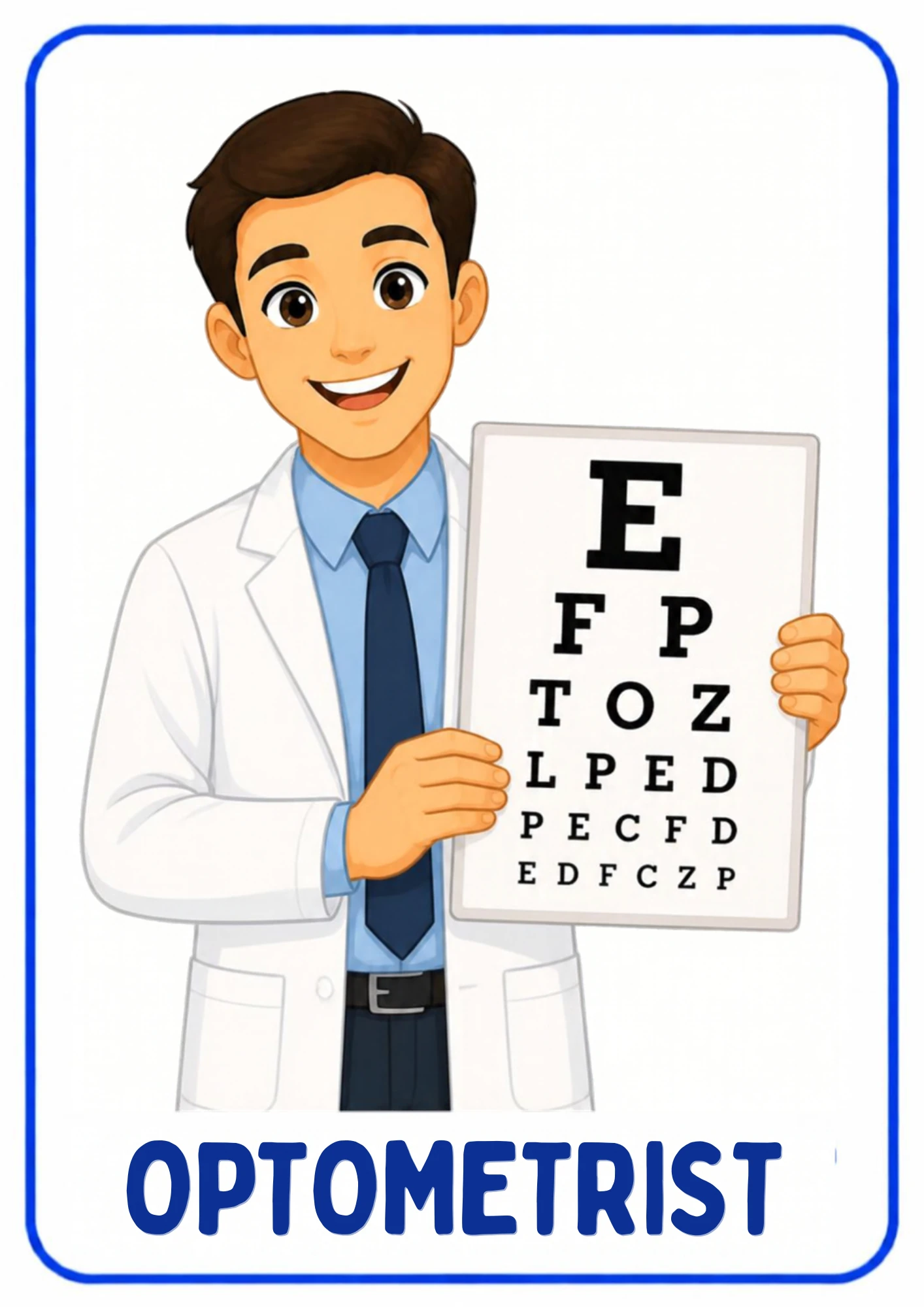
What is this?
An optometrist is an eye helper who checks how well eyes see and finds glasses when eyes need extra help.
What does it mean?
Eye clinics have a big chair, a chart of letters and pictures far away, a little light to look into eyes, and drawers of trial glasses to try.
What does the child need to know?
Eye know-how: eye tests are games of naming what you see; some eyes need glasses to see clearly; glasses are helpers, like helmets for vision.
Why this matters
Children with blurry vision often do not know — blur is their normal. Making eye tests ordinary and game-shaped means early help instead of years of squinting.
What it teaches
Self-report skills ("it is clearer now!"), one-eye-at-a-time control, naming-and-matching practice, and the normalisation reflex: glasses = ordinary as socks.
Words to learn
optometristeyesglassesblurrycleareye chart
Say this to your child
“"The optometrist checks how your eyes see. You look at pictures far away and say what they are. If your eyes want extra help, you get glasses — and then the world looks sharp."”
Step by step
- Show the card: "This is an optometrist. They check eyes so everything looks clear and easy to see."
- Find the chart, the glasses, the chair. "Some pictures on the chart are big and some are tiny — the optometrist asks what you can see."
- Explain glasses kindly: "Sometimes the eye’s window needs a little help. Glasses are that help — like goggles for seeing."
- Play the eye-test game: cover one eye, name shapes far away, swap eyes. Both eyes get a turn.
- If a real test is booked, tell the story in advance: chair, chart, "which one is clearer, one or two?"
Look closer at the picture
Ask: what is on the eye chart? What is the optometrist holding near the eyes? Can you find glasses on this card? Who is wearing them?
Ask your child
"Who checks our eyes? What do we do at an eye test? What do glasses do? Who do you know who wears glasses?"
What your child can say or do
The test lines: "I can see a boat/star/apple!" And the honesty line that matters most: "This one is clearer!" — eyes get a vote.
Out in the real world
Glasses-spotting on every outing: the baker, the storybook bear, Grandpa. The more ordinary glasses look, the happier any future glasses day will be.
Try it together
Wall chart game: stick shapes and letters at kid height, step back three steps, name them — one eye, then the other, then both. Your child "tests" you next. (Play, not diagnosis — real checks belong to the optometrist.)
Understanding check
Ask: "Who checks our eyes? What do we say during the test? What do glasses do?" Optometrist + say-what-you-see + helpers = pass.
Parent tips
Watch for squinting, head-tilting, sitting very close to screens or books, and "my eyes are tired" — all gentle reasons to book a real check. Frame any first visit as a game day.
This lesson pairs with the Optometrist flashcard in the library — print it, show it, keep it on the fridge. Back to Community Helpers & Our Neighborhood (Class 33).