
Animal Shelter Worker — solve it right on the sheet.
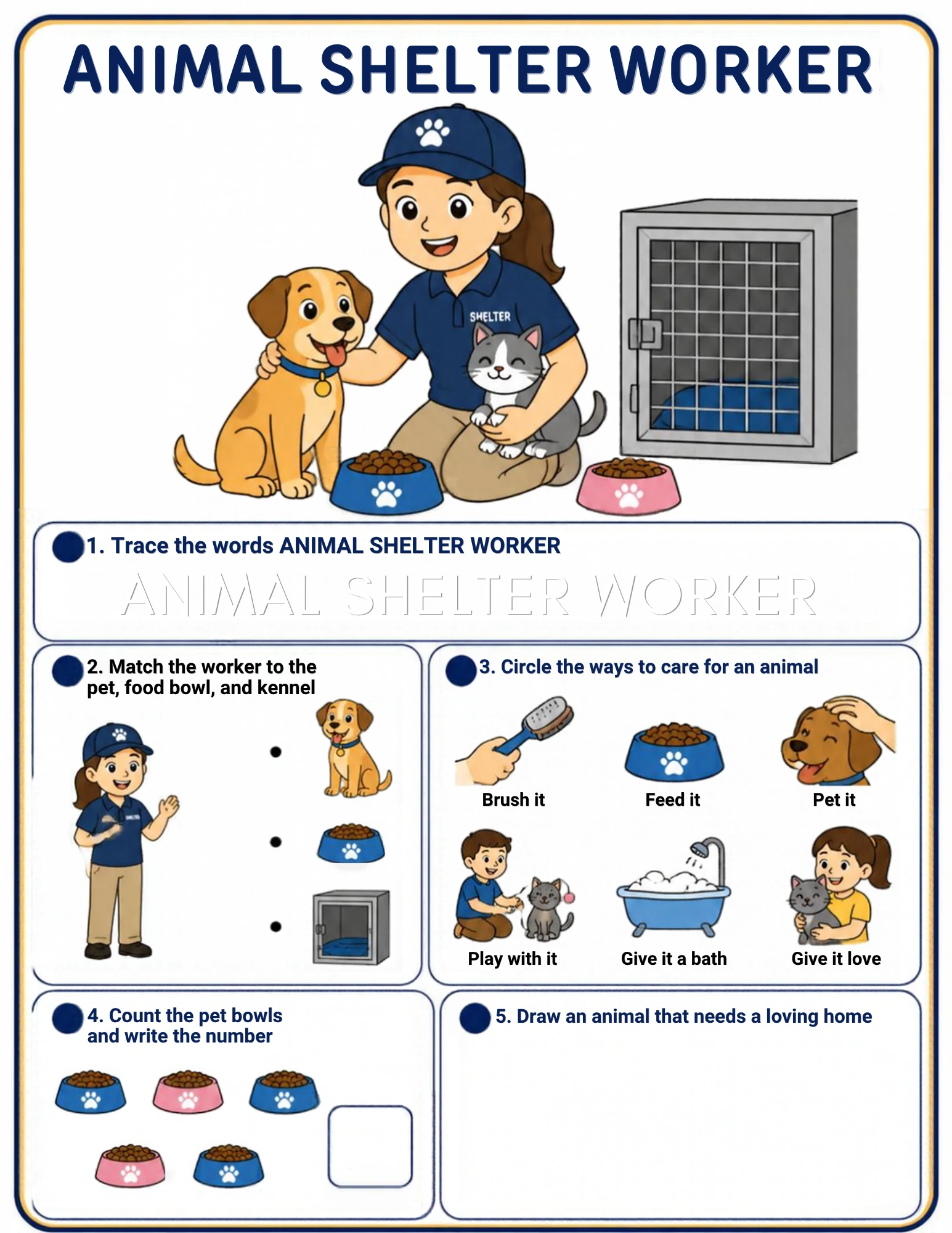
Trace ANIMAL SHELTER WORKER, match the worker to the puppy, the food bowl and the kennel, circle the ways to care for an animal, count the pet bowls and draw an animal that needs a home.
Your sheet is ready.
Pick a color or the eraser, then trace, match, circle, count and draw straight on the sheet with your finger, a stylus or the mouse. Press Save my work when you are proud — that is what marks this activity cleared for your child.
What this worksheet teaches.
What the child is learning: What an animal shelter is and who works there, six everyday ways to care for an animal, and the big truth that every animal deserves a loving home — plus how to write a very long job title.
Knowledge to have ready: An animal shelter is a safe waiting place for animals without homes: the kennel is each dog’s own room, the food bowl fills every day, and the worker feeds, brushes, walks and loves every animal until a family comes. Every one of the six caring ways on the sheet is right.
Why this activity matters: This is the empathy sheet of the set: every tile is a kind act, so the circle step becomes a chorus of yeses. Drawing an animal that needs a home gives big feelings a safe place to land — and plants the family conversation about how we help real animals.
- Community helper vocabulary
- Caring actions vocabulary
- Tool matching
- Empathy and kindness
- Word tracing
- Caring drawing
What to say before you start: "This is an animal shelter worker — the helper who takes care of animals while they wait for a family. Trace the three long words, then connect the puppy, the food bowl and the kennel. Now the six pictures: every single one is a way to be kind. Circle them all! Then draw an animal who needs a home — yours would do."
What to look for on the sheet: Find the puppy’s ears and the kennel’s door. In the grid, read each caring way aloud and act it out on a stuffed animal — brush, feed, pet, play, bath, love. Ask which one your child would do FIRST for a nervous new puppy, and why.
Questions to ask along the way: "What is an animal shelter for?" "Which caring ways did you circle — can you do one for a pet today?" "How does a shelter dog feel while it waits?" "What do gentle hands look like?"
Helpful hints without giving it away: There are no tricks in this grid — all six labeled ways are kind ones. The real thinking is in the acting: try each caring way on your teddy and find the one that feels most like you.
Parent tips: Shelters are full of helpers and hopeful animals — call yours and ask about a child-friendly visit or a towel donation; even sorting old blankets is real helping. Gentle-hands practice on stuffed animals is the rehearsal every real pet deserves.
Understanding check: Ask: "Who cares for animals at the shelter? Name two ways to care for an animal. Which one will YOU do today?" The worker, two ways, one today = the sheet landed.
Real-life practice: Do one caring act from the grid for a real or stuffed animal tonight — brush, feed, pet, play, a warm bath or extra love. Then ask your child which way was easiest and which was hardest. Kindness grows by doing.
This activity belongs to Class 33 — Community Helpers & Our Neighborhood on the Learning Path. Progress is saved on this device for the child chosen in My Classroom — and only a real save of finished work marks it cleared, never just opening the page.
How did it go?
One tap, no writing, no name. Pick the face that matches how it went — reactions are counted instantly and stay anonymous.
Parent reviews.
A different thing from the quick faces above: a star rating for the grown-ups, plus an optional line about how it went. Every review is read by the school office before it appears.
No parent reviews yet — yours could be the first.
Parent comments.
How did you use this page Share the game, the moment or the trick that worked in your house. Comments are read by the school office before they appear, and they are about your ideas — never about your child.
No parent comments yet — yours could be the first.