
Eleven Kiwis — a step-by-step lesson for grown-up and child
This lesson steps over the ten border: eleven, the first number with two digits. Your child counts eleven kiwi halves as a ten and one more, learns why eleven refuses to sound like "oneteen", and practices the ten-plus-one bridge.
What is this?
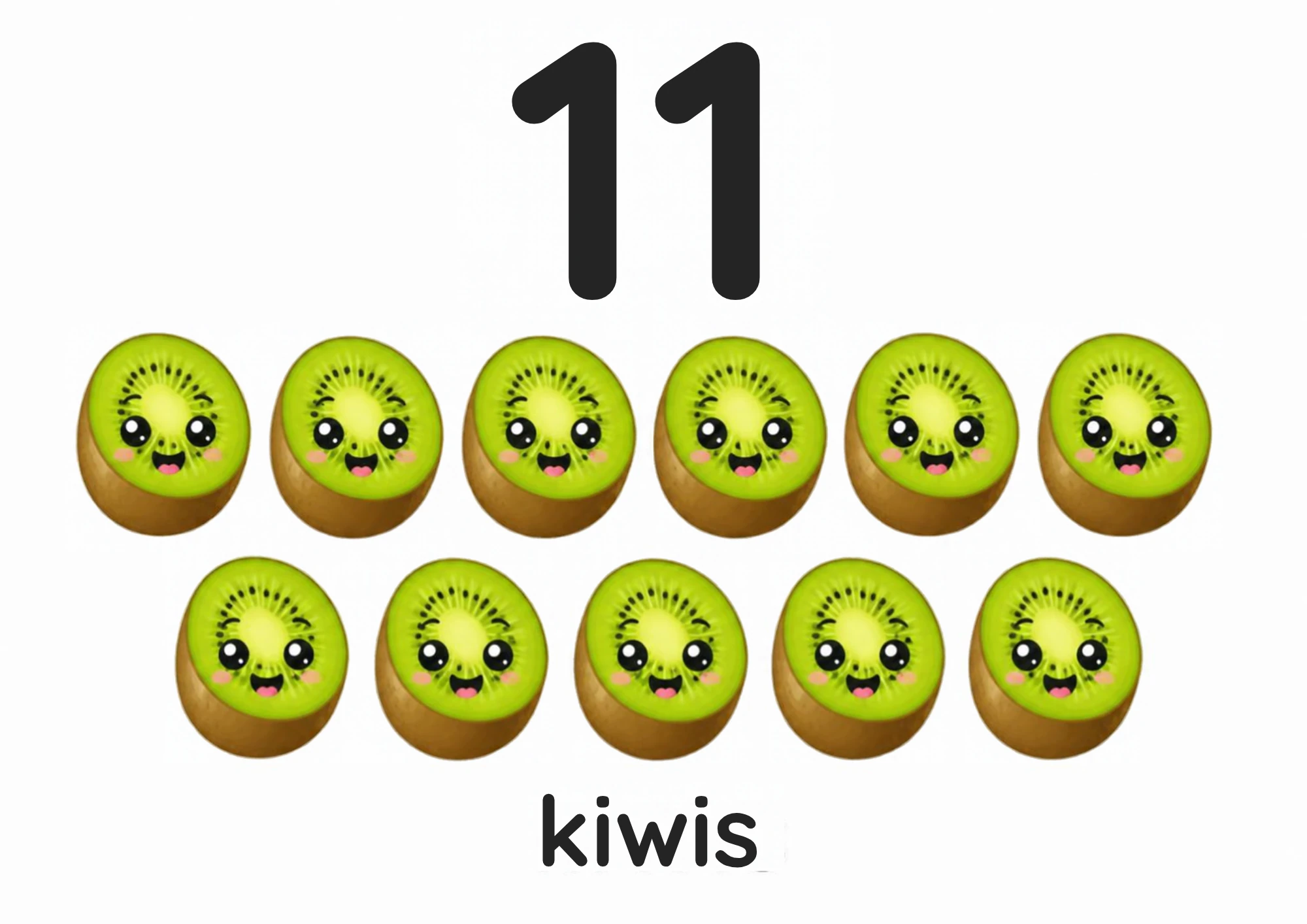
Eleven is ten and one more — the first number that needs two numerals to write. On the card, eleven smiling kiwi halves show their green centres in two rows. Count a full ten, then meet the newcomer: eleven.
What does it mean?
Eleven and twelve are the two rebel teens: they do not say "-teen" like the rest. That is why they get their own cards and their own words. Underneath the funny word, the math is simple and loud: ten and one.
What does the child need to know?
Your child needs three elevens: counting ten and then one more; the word "eleven" as its own word, not a mistake; and the two-numeral idea — the 1 and the 1 side by side mean ten and one more.
Why this matters
Crossing from ten to eleven is the gate into all bigger numbers. If eleven feels like "ten plus a friend", the whole teen decade opens; if it feels like a wall, counting stalls here for months. This lesson makes it a gate.
What it teaches
Two-digit awareness, composing ten and one, flexible counting on from a full ten, and the language insight that number words have history — eleven is old and stubborn and completely learnable.
Words to learn
eleventen and onetwo digitsteenmorebridge
Say this to your child
“"Ten kiwis, and one more — eleven! Eleven is ten and one friend. It does not say oneteen because it is an old, stubborn word, but the math is simple: a full ten and one more."”
Step by step
- Show the card: "Eleven kiwis. First we count a whole ten, then one more arrives. Ten and one: eleven!"
- Count ten kiwis slowly, then tap the last one with a flourish: "and one more — eleven." The one-more tap is the whole lesson; do it twice.
- Look at the numeral: a 1 and a 1 standing together. The first 1 is the ten, the second 1 is the one more. Two digits, one number.
- Build it: count out ten blocks, then let your child add exactly one and announce eleven. Take one away, count again — back to ten.
- Say the word trick: "Eleven does not say oneteen — it is its own old word, like a number with a grandfather's name."
Look closer at the picture
On this card a big black numeral 11 stands over eleven smiling cut kiwi halves showing their green centres in two rows, and the word "kiwis" is printed below.
Ask your child
"How many kiwis? What is ten and one more?" "Which two digits write eleven?" "What number comes right after ten?"
What your child can say or do
Your child might say: "Ten and one — eleven!" "It has two ones!" or the border crossing: "After ten comes eleven, and I know it."
Out in the real world
Elevens sneak into real life: eleven players on a soccer team, the eleventh floor button if you ride high elevators, eleven pipers piping in the song that counts down the twelve days. Sports fans catch this one fast.
Try it together
Ten-plus-one ceremony: any small treat counts out to a full ten, then your child adds the eleventh like a coronation — the one-more gets named out loud. Then race the border: count to ten fast, slow down dramatically, and cross to eleven with one giant step.
Understanding check
Ask: "How many kiwis? What is eleven made of? What word comes after ten?" Eleven kiwis, ten and one, the first teen — the border is crossed.
Parent tips
Do not force "oneteen" logic — eleven is just its own word, and saying so honestly ends the confusion faster than any pattern explanation. The physical one-more tap onto a full ten is worth repeating daily; it is the seed of all place value.
This lesson pairs with the Eleven Kiwis flashcard in the library — print it, show it, keep it on the fridge. Back to Numbers, Counting & Early Math (Class 35).