
Twelve Lemons — a step-by-step lesson for grown-up and child
This lesson counts the grown-up dozen: twelve, the number egg boxes and clock faces are built on. Your child counts twelve lemons in three rows of four, hunts dozens in the kitchen and learns ten-and-two-more.
What is this?
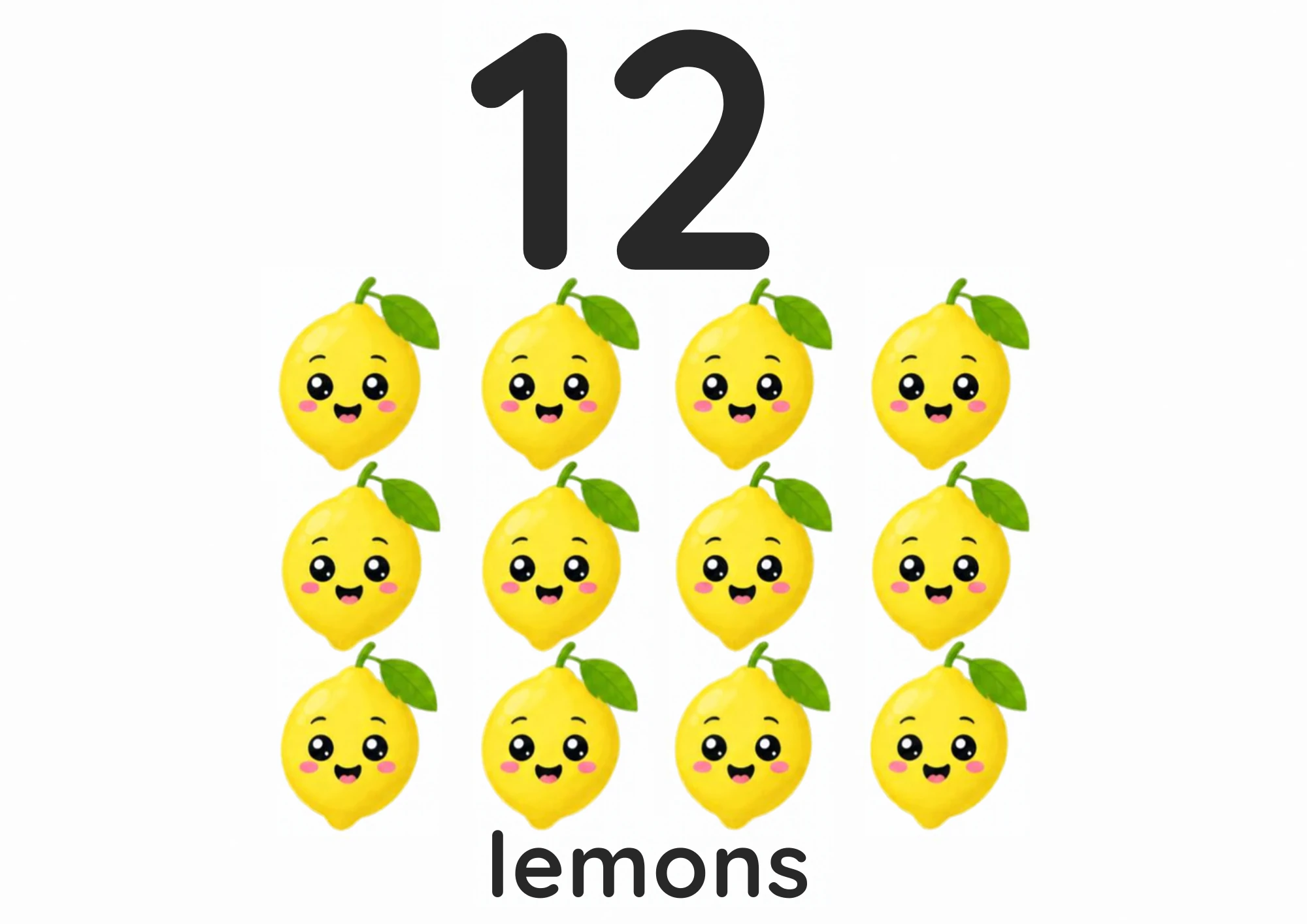
Twelve is ten and two more — twelve lemons in three tidy rows of four. Twelve has a famous grown-up name: a dozen. Egg boxes hold a dozen, bakers bake by the dozen, and every clock wears twelve numbers.
What does it mean?
Twelve matters twice: as ten-and-two in the counting system, and as a dozen in daily life — the first "package number" a child can own. The three-rows-of-four layout also shows that the same twelve can be counted in many shapes.
What does the child need to know?
Your child needs three twelves: counting twelve in rows (four, four, four); the word "dozen" and one real dozen to touch, like an egg box; and the ten-plus-two bridge — a full ten and two friends.
Why this matters
Meeting the dozen early makes shops, kitchens and clocks readable. And counting a dozen in rows is real layout math: three rows of four is the shape of arrays that school math will use for years.
Words to learn
twelvedozenclockrowsten and twobox
Say this to your child
“"Twelve lemons — ten and two more. Twelve is called a dozen: eggs come by the dozen, bakers bake by the dozen, and the clock counts to twelve twice a day. Let us count our own dozen."”
Step by step
- Show the card: "Twelve lemons — and twelve has a special name: a dozen. Let us count them in rows."
- Count row by row: four, then four more (eight), then four more (twelve). Finish a row, start the next — twelve is too long for one look.
- Bridge it: count a full ten lemons, then two more. Ten and two: twelve. Two numerals on top — the 1 for the ten, the 2 for the two.
- Open the kitchen dozen: an egg box, a pack of muffin cups, twelve buttons in a jar. Say "a dozen" each time — the word is the treasure.
- Clock check: find a clock face and count the numbers around it — one to twelve, twice around the day.
Look closer at the picture
On this card a big black numeral 12 stands over twelve smiling yellow lemons arranged in three rows of four, and the word "lemons" is printed below.
Ask your child
"How many lemons? What is a dozen?" "What in our kitchen holds a dozen?" "How many numbers live on a clock?"
What your child can say or do
Your child might say: "Ten and two — twelve!" "A dozen eggs!" or the clock report: "The clock goes all the way around to twelve."
Out in the real world
Dozens rule the kitchen and the shop: a dozen eggs, a dozen roses wrapped in paper, doughnuts sold by the dozen. The clock is the free daily rehearsal — every hour, twelve numbers wait to be counted around.
Try it together
Build a dozen: collect twelve of anything — spoons, cars, socks — and arrange them three rows of four, exactly like the lemons, then rearrange into two rows of six and count again. Same twelve, new shape. Then egg-box math: point at each cup and count twelve.
Understanding check
Ask: "How many lemons? What do we call twelve? What are the rows?" Twelve lemons, a dozen, three rows of four — the package number is learned.
Parent tips
The word "dozen" delights children — it sounds like a secret grown-up code, so hand it over proudly. If row-counting tangles, place one finger at the start of each new row; the row-start habit carries through all of school math.
This lesson pairs with the Twelve Lemons flashcard in the library — print it, show it, keep it on the fridge. Back to Numbers, Counting & Early Math (Class 35).