
Day and Night — a step-by-step lesson for grown-up and child
This lesson answers the classic bedtime question — where does the sun GO at night? — with the biggest idea in the set: the sun goes nowhere. Earth spins, and your side turning away from the light is what night is. A torch and a ball make it visible.
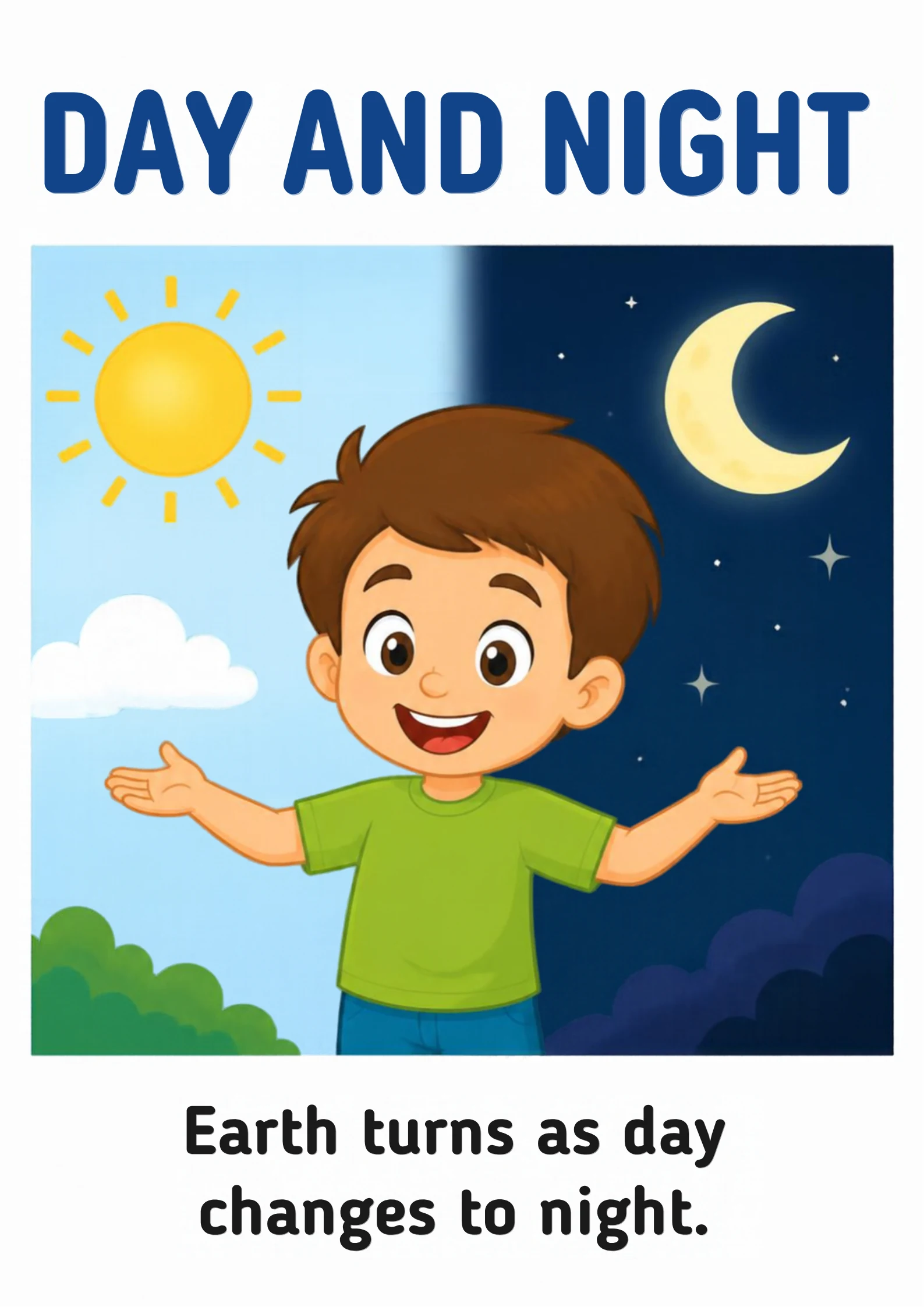
What is this?
Day and night come from Earth spinning like a top: one full turn takes 24 hours, and that turn is what a day means. The side of Earth facing the sun has day; the side turned away has night. We are riding the spin, so the light sweeps past us every 24 hours.
What does it mean?
The sun does not rise or set — it shines steadily while the ground under your feet turns. Sunrise is your spot on Earth rotating into the light; sunset is it rotating out. And bedtime here is playtime on the far side of the world, where children are facing the sun.
What does the child need to know?
Earth turns once every 24 hours — that is what a day is. The spin never stops; nobody feels it because everything turns together. When your child goes to bed, families on the opposite half of the planet are sitting down to breakfast in their daytime.
Why this matters
This is the set’s biggest scale-up: from a garden to a spinning planet. The torch-on-a-ball model makes the invisible rotation visible and answers the night question with mechanics instead of magic — and it quietly explains time zones before bedtime.
What it teaches
Model thinking (ball as Earth, torch as sun), the swap-perspective idea (day here, morning over there), scale — from bedroom to planet — and the deep fact that a day is not the sun’s doing but the ground’s turning.
Words to learn
daynightEarthspinsuntorch
Say this to your child
“"The sun does not go anywhere at night — the Earth turns! Our whole planet spins like a top, one turn every day. When our side faces the sun, it is day. As we turn away, night rolls in — and on the far side of the world, children are waking up to their morning. We are all riding the same spinning ball."”
Step by step
- Show the card: what two scenes can you find — a sunny day side and a starry night side? The child is standing right between them.
- Ask the bedtime question: where does the sun go at night? Collect the guesses, then flip it: the sun stays put — WE turn away.
- Build the model: torch on, ball out. The lit half is having day, the dark half night. Now give the ball a slow turn — day sweeps across it.
- Spin the child: one slow full turn — that took a whole day’s worth. Earth does that in exactly 24 hours, every day, without stopping.
- Try the other side: when it is bedtime here, children on the far side of the world are heading out to play in their morning sun. Same sun, different turn of the ball.
Look closer at the picture
Ask your child: what two scenes can you find in the picture? Which side is day and which is night? Can you find the stars? What is on the sunny half of the picture?
Ask your child
"What is Earth doing right now — standing still or spinning?" "How long does one full spin take?" "Where does the sun go at night?" "When it is bedtime here, what are children on the far side doing?"
What your child can say or do
"WE are the ones spinning — not the sun!" "One turn equals one whole day!" Your child may spin slowly on the spot announcing sunset and sunrise, hold a torch over a globe at bedtime, or wave goodnight to the children whose morning is starting on the far side of the world.
Out in the real world
The spin shows up daily: the sun’s arc across the sky, shadows swinging round the garden, breakfast-afternoon-bedtime in a steady loop. When a faraway cousin sends a breakfast photo at your bedtime, your child has the answer ready: the ball keeps turning.
Try it together
Planet spin game: your child is Earth, a torch-wielding grown-up is the sun. Face the torch — "day!" — turn slowly away — "night!" — one full turn, "a whole day!" Then swap roles and let them call the light. Add a toy animal on their shoulder: does the animal see the sun all day?
Understanding check
Ask: "What makes day and night? How long is one spin? Where does the sun go at night?" Earth’s turning, 24 hours, nowhere — we turn away = landed.
Parent tips
Dim the room for the torch model — the lit half is much clearer. Let your child find the exact spot where their own bedroom sits on the ball and predict its light. The far-side fact lands best with a real map: pick a country, check its bedtime, wonder together.
This lesson pairs with the Day and Night flashcard in the library — print it, show it, keep it on the fridge. Back to Science, Nature & Discovery (Class 31).