
Magnet Force — a step-by-step lesson for grown-up and child
This lesson goes one step past what sticks: force with no contact at all. Your child feels the invisible pull when two magnets meet, the invisible cushion when they argue, and the strangest trick of all — a paperclip lifting while paper stands in between.
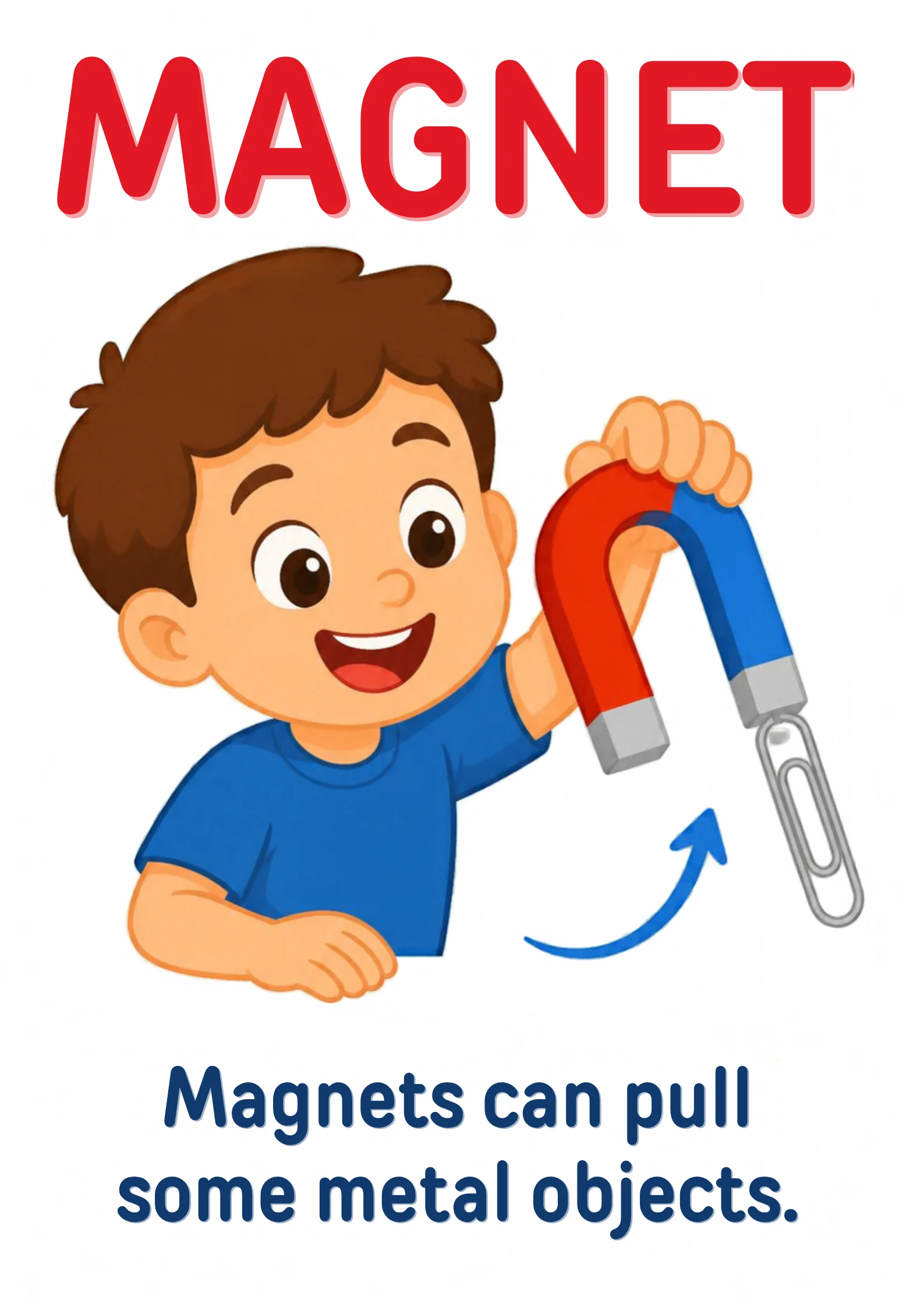
What is this?
A magnet can move things without touching them: it pulls steel from across a gap, and it grips hardest at its two ends — the poles. Turn two magnets the wrong way round and they push apart, no hands needed. The force even works through paper, water and a table top.
What does it mean?
Force at a distance is the wild part: nothing is touching, yet something moves. Every magnet has a north and a south pole, and the rule is absolute — opposite poles pull together, matching poles push apart. The invisible cushion your child feels in their palm is a push they can trust.
What does the child need to know?
Both ends of a magnet are poles — north and south. Opposite poles grab each other; matching poles shove apart. No exceptions, ever. Magnetic force reaches through paper, wood, water and skin, but it fades fast: twice as far away means much less pull.
Why this matters
Feeling a push with no visible cause stretches the invisible-things-are-real idea from wind to a new level — force without contact. It also hands your child a rule with no exceptions (opposites pull, matches push) and the joy of a power they can hold in one hand.
What it teaches
Feeling invisible forces directly (pull, push, through-things), rule-testing (flip the magnet, check the rule), vocabulary — poles, attract, repel — and early physics wonder: this same invisible-force idea grows up into gravity and electricity.
Words to learn
pullpushpolesforceattractdistance
Say this to your child
“"A magnet moves things with no touching at all — that is its superpower. It grips hardest at its two ends, the poles. Turn two magnets so opposite poles meet and they grab each other. Flip one around and they push apart — you can feel the invisible cushion! And the force works through paper and even water. Try it: nothing touches, and things still move."”
Step by step
- Show the card: what is hanging under the magnet, and what is the child lifting with no hands? Name the trick — force with no fingers.
- Feel the pull: hold two magnets loosely, ends toward each other — let them snap together and feel the grab. That force crossed the gap with no touching.
- Feel the push: flip one magnet and try again — the same ends shove apart like an invisible cushion. Opposite poles pull, matching poles push. Always.
- Break the barrier: slip a sheet of paper between the two — the clip still lifts! The force goes through things. Try a table top, a book, a cup of water.
- Map the poles: name the two ends north and south, test all four combinations, and let your child announce the rule like a law of nature — because it is one.
Look closer at the picture
Ask your child: what is hanging from the magnet? Is the magnet holding the paperclip from above? What colors can you find on the magnet? What is the child lifting without fingers?
Ask your child
"What are the two ends of a magnet called?" "What do opposite poles do — pull or push?" "Can magnet force work through paper?" "What did you feel when two matching poles met?"
What your child can say or do
"Opposites attract — matching poles push apart!" "I felt the invisible cushion — it pushed my hand away!" Your child may float magnets across the table like a duel, test whether the force works through their sleeve, or explain that poles "are the strongest bits of the magnet".
Out in the real world
Magnetic force is at work all over the house: the fridge seal that clicks shut, cabinet latches, the magnetic clasp on a bag, phone cases that snap on. Train sets and magnetic tiles run on the same poles rule your child just felt in the palm of a hand.
Try it together
Magnet maze: draw a maze on card, lay a paperclip "racer" on top, and steer it through from below with a bar magnet — no touching the racer, force through the card only. Then race: two racers, two magnets, first to the finish without lifting the magnet. Steady poles win.
Understanding check
Ask: "What do opposite poles do? What do matching poles do? Can the force work through paper?" Pull together, push apart, yes — through things = landed.
Parent tips
The maze needs a roomy paperclip and slow hands — steer from below, wrists low. For the water trick, drop a steel spoon into a cup and run the magnet up the outside: the spoon follows through the wall. Matching-pole pushes deserve a rerun whenever the mood strikes; the invisible cushion never gets old.
Staying safe
Strong magnets are a small-parts danger for baby siblings: if two are swallowed they can pinch tissue inside the body and cause serious harm — magnet play stays up high, and every piece is counted back in. Big snap-together magnets also pinch fingers viciously; little hands use big magnets, slowly.
This lesson pairs with the Magnet Force flashcard in the library — print it, show it, keep it on the fridge. Back to Science, Nature & Discovery (Class 31).