
Sun — a step-by-step lesson for grown-up and child
This lesson names the engine behind nearly everything your child has learned: plants, weather, shadows, day and night — all run on the sun. One star, 150 million kilometres away, delivers light and warmth straight to the palm of a hand.
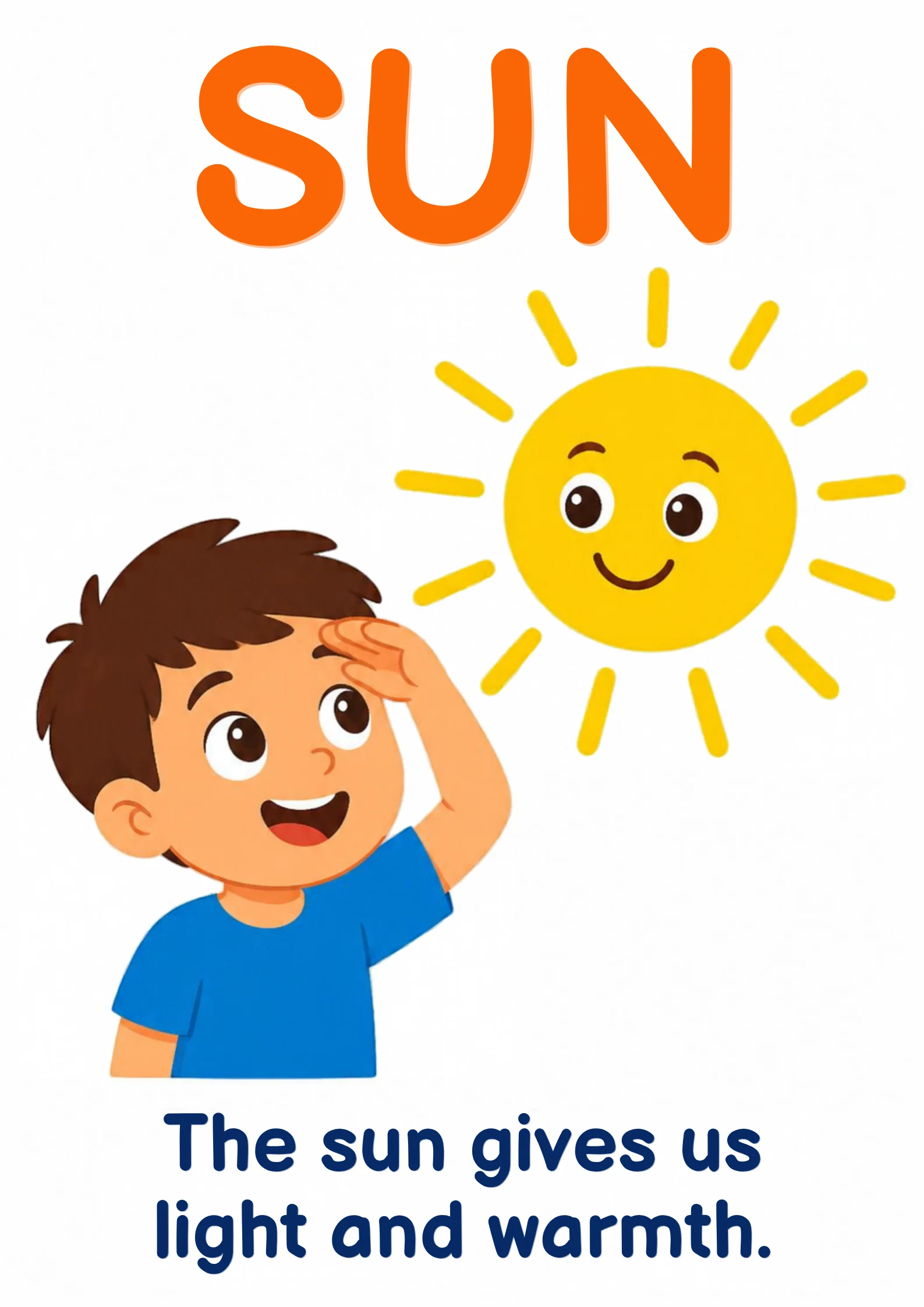
What is this?
The sun is a star — a giant ball of burning-bright gas — and the closest one to Earth. It pours out light and warmth in every direction; a small share lands on us, and that share makes our daytime, grows our food and warms our skin.
What does it mean?
Every other star is a much farther sun: pinpricks of light at night are the same kind of giant ball, just too far to feel. The sun is the engine behind the garden — plants cook with its light, puddles dry from its warmth, and shadows point away from it.
What does the child need to know?
The sun’s warmth travels about 150 million kilometres to reach your hand — and you can feel it. Light and warmth are gifts, but staring is not: looking straight at the sun damages eyes, and sunglasses do not make staring safe. Shade, hats and looking away are the rule.
Why this matters
The sun ties the whole science set together — plants, weather, shadows, the moon’s shine, day and night all borrow its power. Naming it as a star upgrades the night sky: your child now knows that stars are suns, and one of them is ours.
What it teaches
Connecting earlier lessons to one power source (plants, weather, shadows), scale thinking (a star we can feel versus stars we only see), sensory evidence for warmth, and safety rules with reasons that stick.
Words to learn
sunstarlightwarmthshadowshade
Say this to your child
“"The sun is our star — the closest one, a huge ball of burning light and warmth. Its light makes our day, its warmth grows the plants, and you can feel it right on your hand. But it is too bright for eyes: staring is off the table, sunglasses or not. We enjoy the sun by feeling it and looking away."”
Step by step
- Show the card: what is the child doing with their hands, and why? Shading the eyes — exactly what smart sun-watchers do.
- Name it: the sun is a star, the closest one — every other star in the night sky is a far-off sun of its own.
- Feel the delivery: press one palm flat on a sun-baked wall, one on a shaded wall. Feel that difference? The warmth crossed 150 million kilometres to get here.
- Trace the power: plants cook with sun light, puddles dry in sun warmth, shadows point away from the sun. One star, half the set’s lessons.
- Set the rule with its reason: the sun is too bright to look at — staring can damage young eyes for good, and sunglasses do not make staring safe. We feel the sun; we never stare.
Look closer at the picture
Ask your child: what is the child doing with their hands? Is the sun smiling in the picture? Is the child smiling too? Why do you think the child is shading their eyes instead of looking right at it?
Ask your child
"What is the sun — a planet or a star?" "What does the sun give us?" "How far did the warmth on your hand travel?" "Why do we never stare at the sun?"
What your child can say or do
"The sun is a star — OUR star!" "Every star is a sun, just far, far away!" Your child may feel walls, pavements and railings for sun warmth and report the heat, shade their eyes like a salute on every sunny walk, or correct anyone who calls the sun a planet.
Out in the real world
Sun power is daily life: washing drying, tomatoes ripening, the hot slide at noon, the cold side of the house in shade. Once your child names the sun as the engine, the garden becomes a powered system — and the night sky becomes a field of far-off suns to wonder at.
Try it together
Warmth treasure hunt: find five warm things the sun made — a sunny wall, a metal railing, the car bonnet, a paving stone, the sandbox — and five cool things in shade. Rank them hottest to coolest. The sun’s fingerprints, collected by hand.
Understanding check
Ask: "What is the sun? What does it give us? Can we look straight at it?" Our nearest star, light and warmth, never — and now we know why = landed.
Parent tips
Run the two-wall warmth compare on every sunny day — the palm test never gets old. Midday summer sun is hat, shade and water-bottle weather; the science lesson pairs perfectly with the practical one. Save star-gazing for after dark: the night sky is the sun’s family photo.
Staying safe
The sun is a never-stare rule, full stop: looking straight at it burns the light-catching back of the eye, and the damage is permanent — sunglasses are for comfort, not permission. Shade and hats do the protecting on bright days, and the warm-wall test is the safe way to study the sun: feel it, never face it.
This lesson pairs with the Sun flashcard in the library — print it, show it, keep it on the fridge. Back to Science, Nature & Discovery (Class 31).