
Autumn — a step-by-step lesson for grown-up and child
This lesson turns autumn into the collecting season: why the leaves change and fall, how to build a leaf collection worth keeping, the raking-and-jumping tradition, the sweater switch in the wardrobe — and why autumn wind keeps taking hats.
What is this?
Autumn is the season after summer: days shorten, air cools, and deciduous trees stop making green, letting gold, orange and red show instead — then let the leaves go, one gust at a time.
What does it mean?
Autumn is the great change-and-fall season: leaves stop making their green food, show their hidden colours, then drop to feed the soil. The cooling air asks for sweaters. The season’s winds pick up — which is why autumn walks come with hat-holding.
What does the child need to know?
Your child needs three autumn ideas: leaves change colour because the tree is resting for winter, then fall to feed the ground; autumn air asks for sweaters and light layers; and autumn wind is playful — hats get held, and leaf heaps get jumped in.
Why this matters
Autumn is the classification season: leaves by colour, shape, size, tree. Sorting a real, beautiful collection is early-maths and early-science in one afternoon. The visible cooling also ties calendar to wardrobe — the child who packs away the summer clothes has understood the season, not just watched it.
What it teaches
Sorting and classifying with real objects, seasonal cause-and-effect (less sun, cooler days, colour change), collection-building and care, wardrobe switching as life-admin practice, and gross-motor joy in raking and jumping.
Words to learn
autumnleafgoldrakesweatergustcrunchharvest
Say this to your child
“"Autumn is the leaf season. The trees turn gold and orange, then let their leaves go — the wind helps them fly. We wear our sweaters, we rake the leaves into heaps, we collect the prettiest ones, and we hold our hats when the autumn wind comes dancing."”
Step by step
- Show the card: "Autumn is when the leaves turn gold and orange and fall down for a rest."
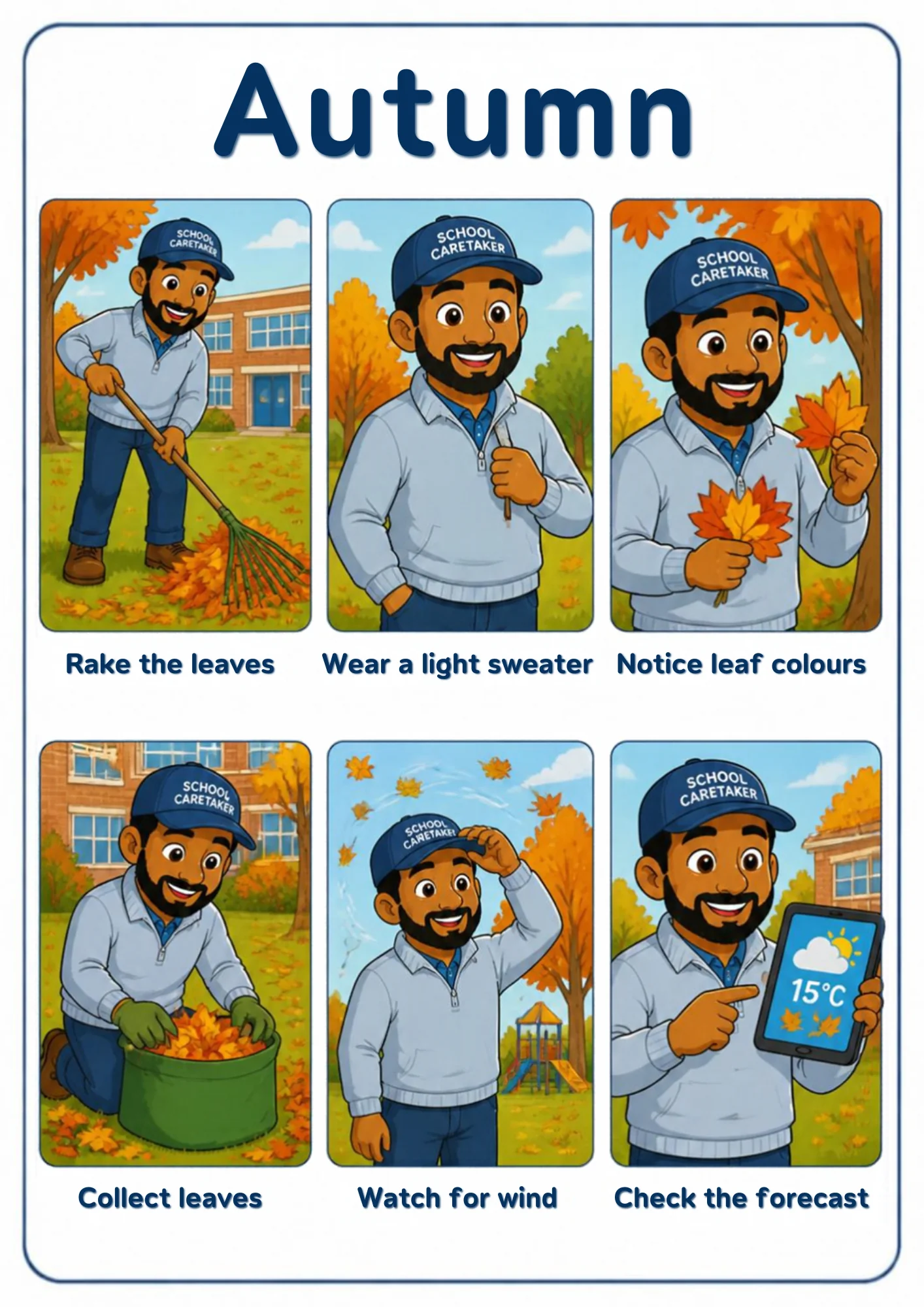
- Read the picture: the school caretaker in a cap rakes leaves into a heap by the school, wears a light grey sweater, holds up maple leaves in orange and yellow, kneels to collect leaves into a big green bag, holds his cap on in the wind as leaves fly, and points at a forecast reading 15°C.
- Start the collection: gather ten fallen leaves — different colours, shapes, sizes. Sort them at the kitchen table: by colour, then size, then shape. Keep the best in a heavy-book press.
- Do the sweater switch: which clothes are autumn clothes? Let your child move the summer things away and lay out the jumpers.
- Practise hat-holding: autumn wind tests hats. Hand on head at the gusty bits — and if it blows off, we chase it, laughing, and hold on tighter.
Look closer at the picture
On this card a school caretaker in a navy cap, light-grey zip sweater and navy trousers works around a school building: he rakes orange leaves into a heap beside an orange-leafed tree, stands smiling in his sweater, holds up two maple leaves — one orange, one golden — kneels packing leaves into a tall green garden bag, steadies his cap with one hand as leaves swirl past a playground slide, and points at a tablet forecast showing a cloud icon and 15°C.
Ask your child
"Why do the leaves change colour?" "What did we put in our collection today?" "What do we wear now the air is cooler?" "What does the autumn wind love to take?"
What your child can say or do
Your child might say: "Our tree went full gold this week!" "Sweater weather — I picked the blue one," or the wind report: "I held my hat with ONE hand — the wind tried!"
Out in the real world
Walk the leaf-line: which trees turned first, which are still green? Find the leaf-workers — caretakers, sweepers, the wind itself. Visit a market or farm at harvest time and name what autumn ripened: apples, pumpkins, plums. Notice the darker mornings — autumn is shortening the days.
Try it together
Leaf-olympics: best colour, biggest, funniest shape, most points. Rake-and-jump: a proper heap, a proper jump, a proper repeat. Leaf-art: rubbings with crayons over the ridges, collages of the collection. And the tree-watch begins: adopt your tree now, so winter’s bare branches are a story, not a surprise.
Understanding check
Ask: "What happens to the leaves in autumn? What do we wear? What does the wind take?" Change-and-fall, sweaters, and hats — the golden season is officially collected.
Parent tips
Let the collection be the child’s — messy, abundant, curated by enthusiasm rather than by adult taste. The heavy-book press is the museum, and the museum belongs to them. And join the jump: one grown-up cannonball into the leaf heap makes the whole season memorable.
Staying safe
Autumn rules: dewy and leafy slopes are slippery — walking feet down leafy banks; shorter, darker days mean something bright on jackets for the roadside walk; and leaf piles at the kerb are never for jumping — garden heaps only, where no traffic passes.
This lesson pairs with the Autumn flashcard in the library — print it, show it, keep it on the fridge. Back to Weather, Seasons & What We Wear (Class 34).