
Summer — a step-by-step lesson for grown-up and child
This lesson gives summer its structure: the longest, brightest days, the hat-sunscreen-water routine that never takes a day off, the swim rules that matter most, and how to read a beach flag like a local — all so the golden season stays pure joy.
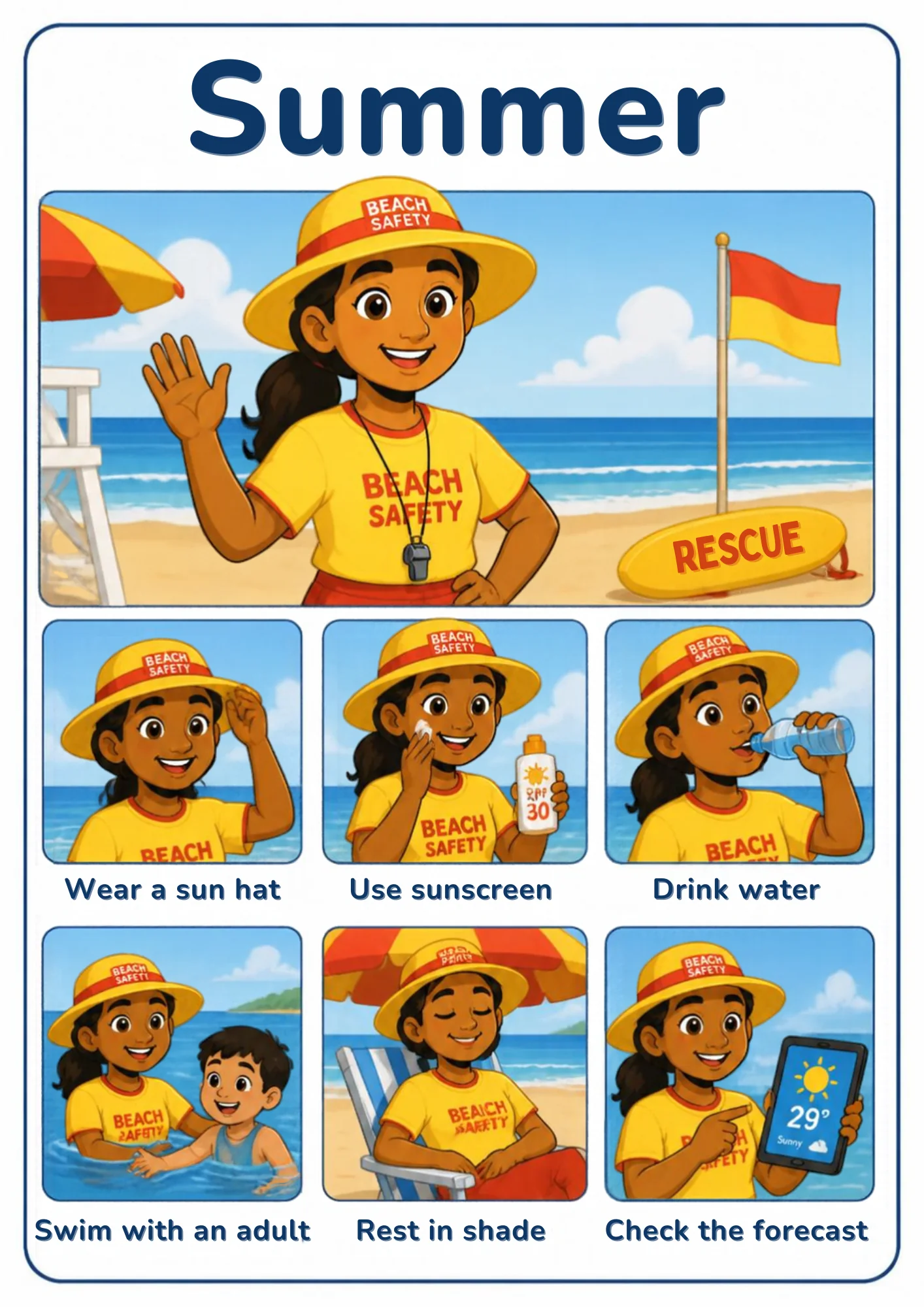
What is this?
Summer is the warmest season: the longest days and strongest sun, holidays from school, the beach and the pool at their best, fruit ripening everywhere and daylight stretching right into the evening.
What does it mean?
Summer fun runs on summer rules. The sun is strong all day, so hats, sunscreen and shade at midday are how the day works — not optional extras. Swimming happens where lifeguards watch, between the flags. And the long light plays tricks: bedtime says sleep while the sky says play.
What does the child need to know?
Your child needs three summer ideas: summer sun is strong — hat, sunscreen by a grown-up and water all day, every day; we swim only where a watching grown-up and the lifeguards can see us, between the red-and-yellow flags; and the strongest-sun hours are for shade forts, slow games and long cool drinks.
Why this matters
Summer carries the season’s biggest safety stakes and its biggest joys in the same hours. The child who learns the flag system, the watch-me-swim rule and the midday-shade rhythm at four and five owns them for every summer after — this is the class’s most lasting lesson wearing its happiest face.
What it teaches
Rule ownership (flags, swim-with-a-grown-up), routine persistence through holiday looseness, time concepts through daylight tracking, water confidence with supervision, and the self-knowledge of reading one’s own thirst, heat and tiredness.
Words to learn
summerlifeguardflagsunscreenmiddayshadepaddleripened
Say this to your child
“"Summer is the long, bright, beach season. We wear our hats, we drink water all day, we rest in the shade when the sun is strongest — and we swim only where a grown-up is watching and the red-and-yellow flag says the lifeguards can see us. Then summer is all joy, all season."”
Step by step
- Show the card: "Summer is the season of long bright days — and the sun plays by strong rules."
- Read the picture: the beach-safety lifeguard in a yellow hat and shirt waves on the sand beside a red-and-yellow flag on a pole and a rescue board; the panels show her adjusting the sun hat, rubbing sunscreen from a bottle, drinking water, swimming in the sea with a small child, resting in a striped chair under an umbrella and pointing at a sunny forecast reading 29 degrees.
- Learn the beach flags like treasure signs: red-and-yellow means lifeguards watch this stretch — we swim between the flags, always in sight of our grown-up.
- Fix the routine as a song: hat, sunscreen, water bottle — every day, no holidays from the routine, even when the day feels easy.
- Plan the midday like the card: the strong-sun hours are for shade — a fort, a striped chair, a long drink — then back out when the sun mellows.
Look closer at the picture
On this card a beach-safety lifeguard in a yellow wide-brim hat and yellow "beach safety" shirt stands waving on the sand: behind her fly a red-and-yellow flag on a pole and a yellow rescue board marked RESCUE, with a lifeguard chair and a striped umbrella nearby; the panels show her adjusting her hat, rubbing sunscreen from a bottle onto her cheek, drinking from a bottle, standing waist-deep in the sea with a small boy, dozing happily in a striped beach chair under an umbrella, and pointing at a phone forecast reading 29° with a sun icon and the word Sunny.
Ask your child
"What do the red-and-yellow flags mean?" "Who watches us when we swim?" "What are the midday hours for?" "What never takes a holiday in summer?"
What your child can say or do
Your child might say: "Between the flags, near my grown-up!" "Midday is shade-fort time," or the routine anthem: "Hat, sunscreen, bottle — every day!"
Out in the real world
Read the flags at every beach and pool visit — red-and-yellow for swimming, and ask the lifeguard together what today means. Spot the summer routines on the sand: hats, umbrellas, cool boxes, the lifeguard’s high chair. Track the long light: what time does the sun set this week — and next?
Try it together
Flag-game in the garden: one child waves red-and-yellow — swimming happens "between" two towels, grown-up in the middle. Shade-fort engineering contest for the midday hours. Fruit-ice lolly kitchen: freeze juice with berries. And the summer classic: an evening walk in the golden light, tracking how late the shadows stretch.
Understanding check
Ask: "What do the flags mean? Who watches at swim time? What never takes a summer holiday?" Lifeguards-watch, my-grown-up, and hat-sunscreen-water — the golden season is now safe to love completely.
Parent tips
Hold the routine through the holiday looseness — summer is when routines quietly dissolve, so anchor just three (hat, water, swim-with-a-watching-grown-up) and defend them warmly. And answer "why?" fully once: children follow rules they understand; "so the lifeguard can always see you" beats "because" every time.
Staying safe
Summer’s big rules: never swim without a watching grown-up, only between the flags where lifeguards watch; hats and sunscreen every day, shade at midday; never sit in a parked car; and come to a grown-up at once for any dizzy, headachy or sick feeling in the heat.
This lesson pairs with the Summer flashcard in the library — print it, show it, keep it on the fridge. Back to Weather, Seasons & What We Wear (Class 34).