
Scarf and Gloves — a step-by-step lesson for grown-up and child
This lesson adds the neck-and-finger team to the cold-day kit: why those bits chill first, the scarf wrap that is snug but never tight, gloves-versus-mittens by feel, the warm-finger check — and the tuck-it-in rule that keeps scarves safe on climbing frames.
What is this?
A scarf is a long soft strip of fabric wrapped around the neck to hold warmth in. Gloves give every finger its own cosy sleeve; mittens keep all the fingers together in one warm pouch.
What does it mean?
Necks and fingers are the body’s cold-out posts — thin skin, far from the warm middle, always exposed. That is why they feel the cold first and why the scarf-and-glove team matters: the scarf holds a pocket of warm air at the neck, and covered fingers keep their wiggle for playing.
What does the child need to know?
Your child needs three scarf-and-glove ideas: necks and fingers feel cold first, so they get dressed on purpose; the scarf wraps snug — never tight — with ends tucked in; and on playgrounds the rule is tucked or off, because loose ends can catch on slides and frames.
Why this matters
This lesson teaches precision care: warm is not just more layers, it is the right layers on the bits that need them. The wrap on teddy then on self builds the skill gently; the mittens-versus-gloves choice gives the child a real decision; and the tuck-in rule folds safety into the garment itself.
What it teaches
Fine-motor wrapping and tucking, body-map awareness (which bits chill first), choice-making (mittens or gloves today?), caring-for-others practice via teddy, and safety reasoning about loose ends and equipment.
Words to learn
scarfwrapsnugglovesmittensfingerstuckwarm
Say this to your child
“"On cold days our neck and fingers feel the cold first, so we wrap our scarf snug — around, then tuck the ends in — and pull on our gloves or mittens. Wiggle test! And when we play on the climbing frames: tucked or off, because loose ends catch."”
Step by step
- Show the card: "Necks and fingers get cold first — so we dress them on purpose."
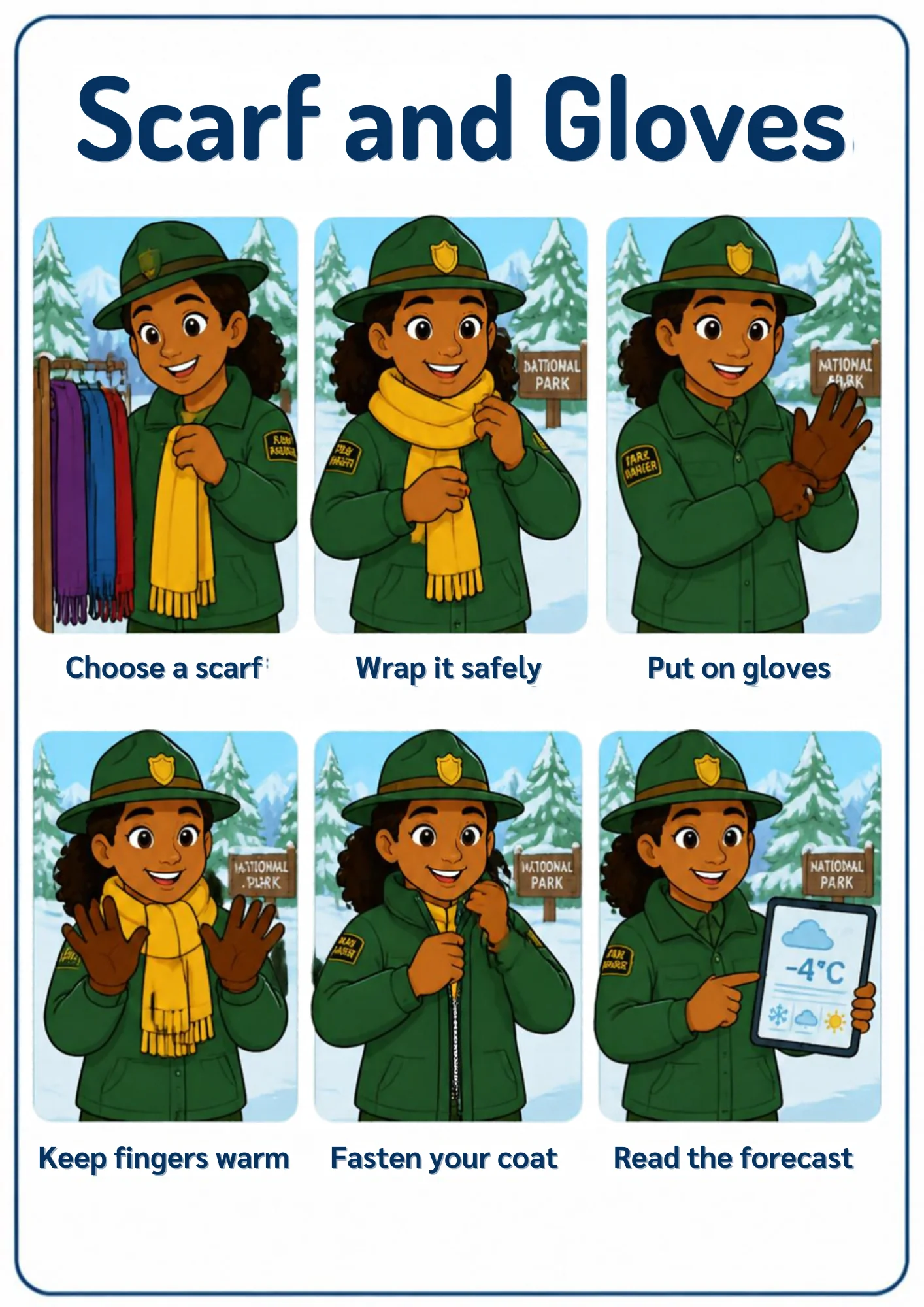
- Read the picture: the park ranger in a green hat and jacket picks a yellow scarf from a rack of purple, blue and red scarves, wraps it around her neck in the snowy park, pulls on a brown glove, wiggles both gloved hands warm, zips her jacket over the scarf and points at a forecast reading minus 4 degrees.
- Learn the wrap in two steps: around the neck, then tuck the ends in — snug enough to feel cosy, loose enough for one finger underneath. Practise on yourself, then on teddy (teddy sits very still and appreciates everything).
- Do the mitten-versus-glove try-on: which lets your fingers wiggle apart? Which feels warmer right now? Let your child choose by feel — both are right.
- Set the play rule like a rhyme: "Tucked or off for the slide and the climb" — loose, long ends stay home or get tucked before any playground gate.
Look closer at the picture
On this card a park ranger in a green wide-brim hat with a badge and a dark green jacket stands in a snowy national park with pines and a park sign: she picks a yellow scarf from a wooden rack of colourful scarves, wraps the yellow scarf snugly around her neck with both hands, pulls a brown glove onto one hand, holds up both brown gloves with fingers spread, fastens her jacket zipper over the scarf, and points at a tablet reading −4°C with cloud and snowflake icons.
Ask your child
"Which bits feel cold first — and why?" "Show me the snug wrap." "Mittens or gloves today — and how do they feel different?" "What is the playground rule for scarves?"
What your child can say or do
Your child might report: "Snug but one finger loose — perfect!" announce the choice: "Mittens today — warmest!" or recite the rhyme: "Tucked or off for the slide!"
Out in the real world
Watch the winter workers: every builder, ranger and dog walker has the neck-and-finger team on. Try the one-hand-in-cold-air test on the walk: gloved hand and bare hand, same wind — which taps the fence longer? Clip or string your child’s mittens to the sleeves and never chase a lost one again.
Try it together
Teddy-wrapping school: the wrap, the tuck, the praise. Mitten race: hands in, thumbs out, first up wins — then reversed with the non-favourite hand. Warm-finger science: bare-hand versus gloved-hand in the cold air, timed by who gives up first. And the rhyme-run at every playground gate: "Tucked or off!" before the first climb.
Understanding check
Ask: "Which bits chill first? How snug is the wrap? What happens to scarf ends at the playground?" Neck-and-fingers, one-finger-loose, and tucked-or-off — the team is now on duty.
Parent tips
Buy duplicates of the mitten your child loves — the lost-mitten tax is real and pre-paying it preserves peace. Let the choice live with the child (mittens or gloves, scarf colour, wrap style) inside the two rules: snug-not-tight, tucked-or-off. And wrap teddy first, always: the skill lands softer through paws.
Staying safe
Scarf and glove safety: snug, never tight — one finger must fit under the wrap; ends tucked in, and on slides or climbing frames the rule is tucked or off entirely; no long cords attaching mittens through coat hoods or car seats; and wet mittens get swapped for dry at the radiator, not endured.
This lesson pairs with the Scarf and Gloves flashcard in the library — print it, show it, keep it on the fridge. Back to Weather, Seasons & What We Wear (Class 34).