
Sunglasses — a step-by-step lesson for grown-up and child
This lesson completes the sun-safety set: what glare is and why eyes squint, the two-hands-on routine for real glasses, the mirror fit check, where glare is strongest — water, sand, snow — and the golden rule that stays true with or without glasses: never stare at the sun.
What is this?
Sunglasses are glasses with dark lenses that cut down bright light and glare. They come in every frame colour, in child sizes, and they live in a case or on a hook when the sun goes in.
What does it mean?
Bright light bounces — off water, sand, snow, pale pavements — and that bounced glare is what makes eyes squint and water. Sunglasses dim the glare so eyes stay comfortable. They are comfort gear for bright days, and they work as the third member of the sun team: hat, shade, glasses.
What does the child need to know?
Your child needs three sunglasses ideas: sunglasses dim glare so eyes stay comfy in bright light; the routine is two hands, gently on, comfy check in the mirror; and the golden rule never changes — sunglasses or not, we never look straight at the sun.
Why this matters
Sunglasses are a child’s first owned optical device — putting them on carefully, storing them safely, understanding what they do. The care routine (case, not pocket) and the honest physics (glare bounces) make this a small lesson with big cross-over: respect for tools, respect for eyes.
What it teaches
Two-handed fine-motor routine, tool care and storage, light-compare observation, the body-signal link (squinting means glare), and rule-keeping under temptation — the never-stare rule tested and held.
Words to learn
sunglassesglarebrightlensesdimfitcasesquint
Say this to your child
“"On very bright days we wear sunglasses — they turn the brightness down so our eyes stay comfy. Two hands, gently on, comfy check in the mirror. And the big rule never changes: we never look right at the sun, with or without glasses."”
Step by step
- Show the card: "Sunglasses are dimmers for our eyes on very bright days."
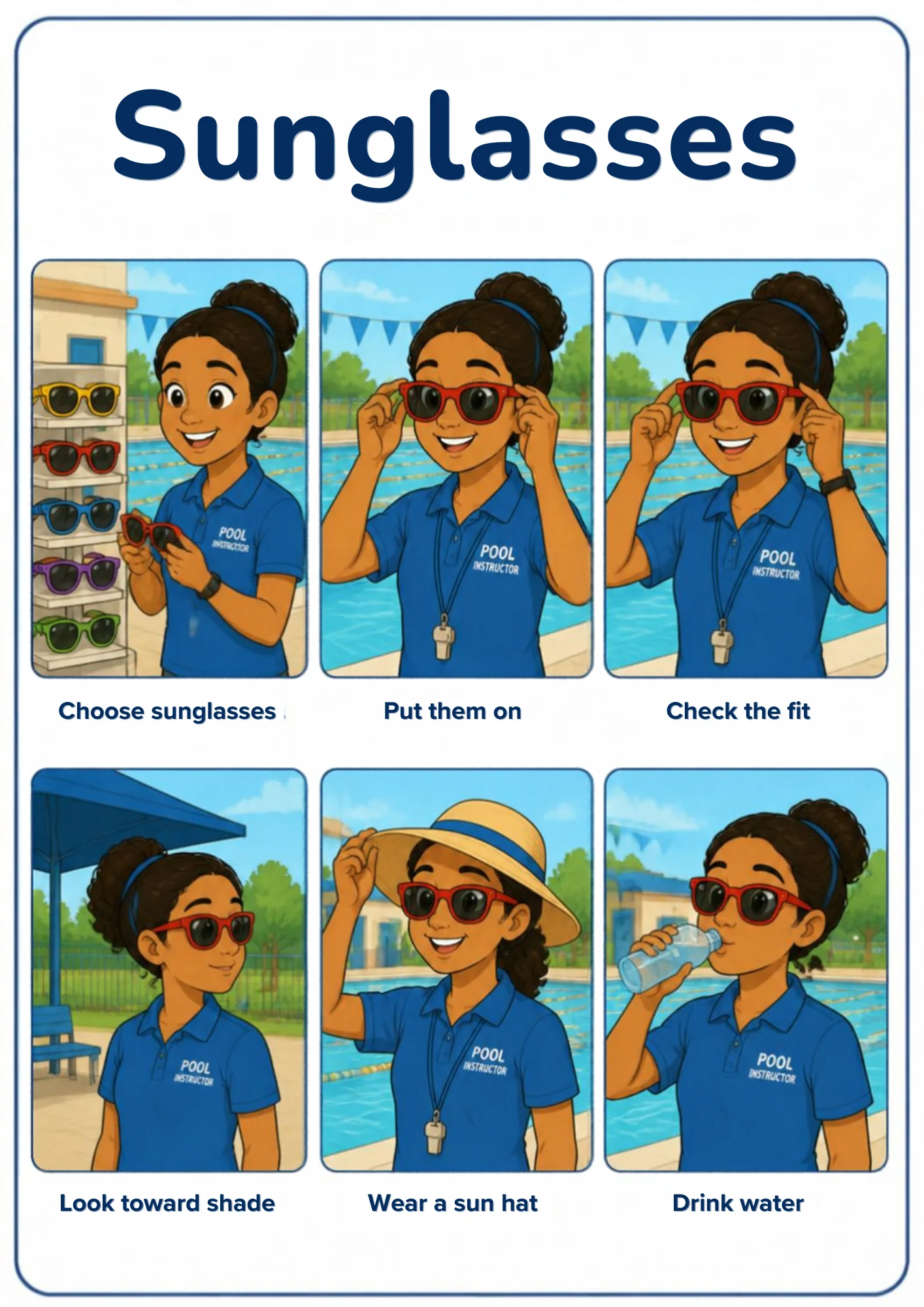
- Read the picture: the pool instructor in a navy polo picks red sunglasses from a display rack of yellow, red, blue, purple and green pairs, puts them on with both hands, adjusts the arms over her ears for fit, stands looking toward a shaded canopy by the pool, wears them with a straw sun hat, and drinks from a clear water bottle with the pool bright behind her.
- Teach the routine as three moves: BOTH HANDS (one each side), GENTLY ON, COMFY CHECK (mirror, straight, no pinch). Practise until it is smooth and slow — glasses are handled, never grabbed.
- Do the light-compare: bright room, then sunglasses on — how did the light change? That dimming is the glasses doing their job for the eyes.
- Set the golden rule in stone: sunglasses dim the glare, but they are never a licence to stare — the sun is a no-look, always, with or without glasses.
Look closer at the picture
On this card a pool instructor with dark curly hair in a navy "pool instructor" polo and a whistle lanyard: chooses red sunglasses from a display rack holding yellow, red, blue, purple and green pairs, puts them on with both hands by the pool, adjusts the arms over her ears, stands in profile looking toward a blue shade canopy and bench, wears the red glasses under a straw sun hat while adjusting the brim, and drinks from a clear bottle with the sparkling pool and bunting behind her.
Ask your child
"What do sunglasses do for our eyes?" "Show me the two-hands routine." "Where does glare bounce the most?" "What is the golden rule about the sun?"
What your child can say or do
Your child might say: "Squinting means glare — glasses please!" run the routine solo: "Two hands, gently on, comfy check," or guard the rule: "Never stare — not even with glasses on!"
Out in the real world
Feel the glare by water, sand or fresh snow — bounce you can see. Spot who wears glasses for work: lifeguards, sailors, skiers, drivers — all glare-fighters. Let your child carry their own pair in its own case: tool care is the hidden curriculum of this lesson.
Try it together
Mirror-school for the two-hands routine until it is ballet. Light-compare lab: sunny window, glasses on-off — report the change. Glare hunt with hats on: which spot by the pond bounces hardest? Choose-your-pair from two options — then the care routine: case click, hook hang, never the pocket.
Understanding check
Ask: "What do sunglasses dim? What is the handling routine? Does the never-stare rule change with glasses on?" Glare, two-hands-gently, and never-never — eyes officially equipped.
Parent tips
Let some children opt out happily — the hat and the shade carry the load, and glasses are a bonus layer, not a battle. Pick real-dim lenses over toy dress-up sets if real wearing is the goal. And rehearse the never-stare rule out loud with the glasses ON: dark lenses can make staring feel safe when it is not, and saying so beats hoping.
Staying safe
Sunglasses safety: two hands, gentle handling — grabbed glasses break and broken bits are eye-hazards; real-dim lenses, not clear dress-up toys, if comfort is the goal; cases protect lenses and eyes alike; and the golden rule stands over every other line in this lesson — never look straight at the sun, with or without any glasses at all.
This lesson pairs with the Sunglasses flashcard in the library — print it, show it, keep it on the fridge. Back to Weather, Seasons & What We Wear (Class 34).