
Stormy Day — a step-by-step lesson for grown-up and child
This lesson takes the fear out of the sky’s loudest weather: what lightning and thunder really are, why the boom follows the flash, and the three storm rules from the card’s own poster — plus a thunder-counting game that makes waiting a sport.
What is this?
A stormy day brings dark towering clouds, heavy rain, strong wind, flashes of lightning and rumbles of thunder, all together. It is the sky at its most dramatic — and it usually passes quickly.
What does it mean?
Lightning is a giant spark of electricity jumping inside or between clouds. Thunder is the sound of that spark super-heating the air. Light travels faster than sound, so we always see the flash first and hear the boom afterwards.
What does the child need to know?
Your child needs three storm ideas: lightning is a giant sky spark and thunder is its sound; the flash comes first and the boom chases it; and our storm plan is the poster’s three rules — stay inside, stay away from trees, stay away from plugs and wires.
Why this matters
Storm fear is among the most common childhood fears — and among the most reducible. Naming the order (flash, count, boom) converts a mystery into a countable game; the poster’s rules give the body a script; and a cosy den gives the feelings somewhere warm to sit.
What it teaches
Sequencing (flash → count → boom), counting under mild excitement, fear-processing through play and explanation, family-safety scripting, and the deep reassurance of routines that hold even when the sky does not.
Words to learn
stormlightningthundersparkrumbleinsidesafecosy
Say this to your child
“"A storm makes big flashes and loud rumbles. The flash is lightning — a giant spark — and the boom is thunder, chasing right after it because sound runs slower than light. We stay inside, away from windows, and watch the show together from our cosy spot."”
Step by step
- Show the card: "A storm is a big cloud having a very loud day — and we watch it from our safe, cosy inside."
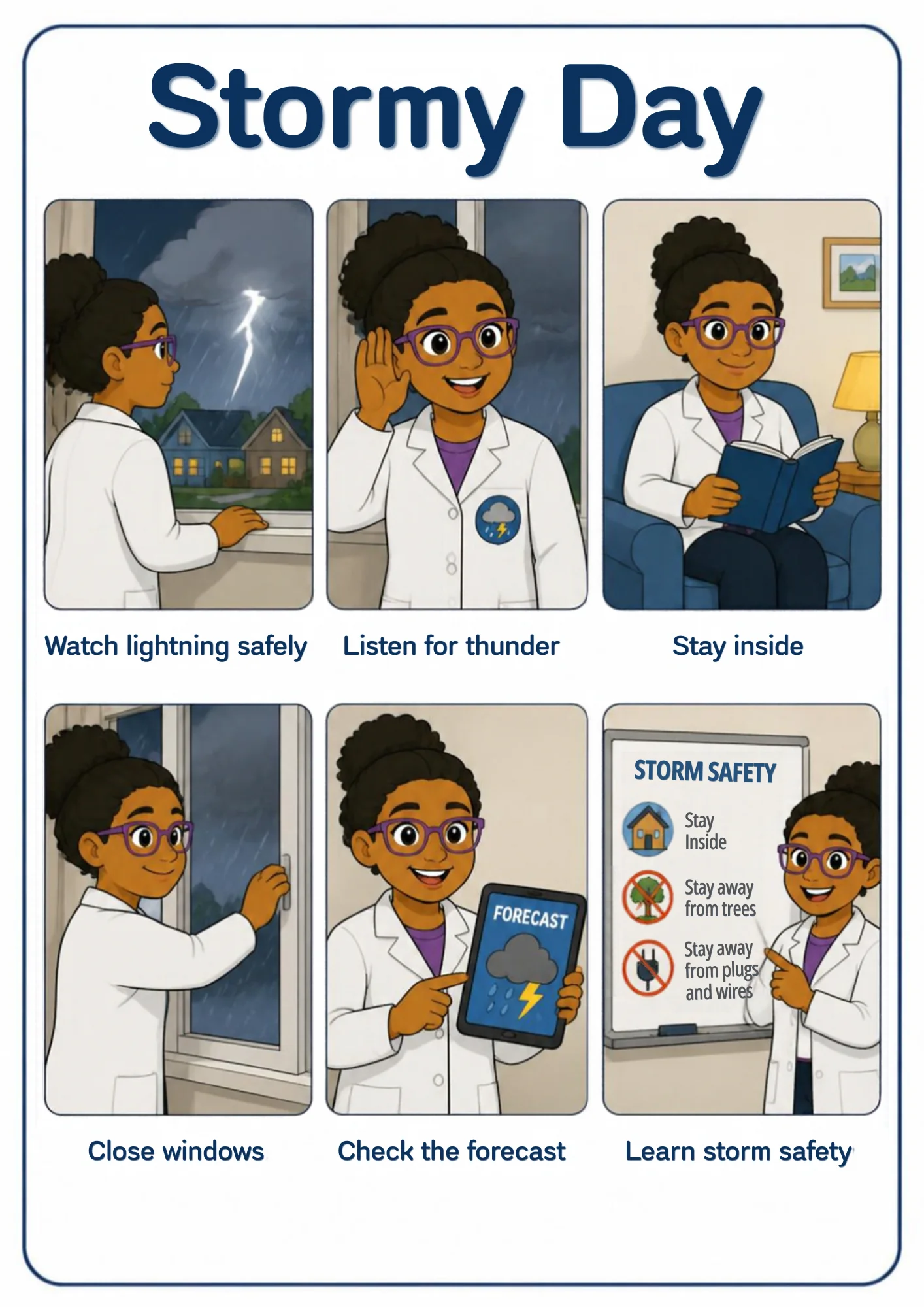
- Read the picture: the scientist watches a lightning flash from her window, listens for thunder with a hand to her ear, reads in an armchair by a lamp, closes the window latch, checks a storm forecast on a tablet and points at a storm-safety poster that says: stay inside, stay away from trees, stay away from plugs and wires.
- Teach the order with hands: flash (fingers flick), count (one-Mississippi, two-Mississippi…), BOOM (stamp). The longer the count, the farther away the storm.
- Walk the three rules as a little march: inside! away from trees! away from plugs! Then draw them as a family poster.
- Build the storm plan: when the forecast says storm, we shut windows, bring in the cushions and make the den — the storm is the TV tonight.
Look closer at the picture
This stormy card keeps a scientist with glasses and a white lab coat indoors: she watches a fork of lightning over dark rooftops through the window, cups her hand behind her ear to catch the thunder, reads a blue book in an armchair beside a glowing lamp, turns the window latch shut against the rain, points at a tablet with a storm-cloud forecast, and presents a "Storm Safety" poster with three picture rules — a house for stay inside, a crossed-out tree for stay away from trees, and a crossed-out plug for stay away from plugs and wires.
Ask your child
"Which comes first — the flash or the boom?" "What is thunder the sound of?" "Name the three storm rules." "What is our family’s cosy storm spot?"
What your child can say or do
Your child might chant the rules as a march: "Inside! No trees! No plugs!" count the flash-to-boom gap proudly, or declare mid-storm: "The storm is far — the count was BIG."
Out in the real world
Watch how the neighbourhood answers storms: windows closing, market stalls packing up, buses easing along, then everyone back out after. Point to lightning rods and safe buildings — grown-ups have been outsmarting storms for centuries, and the house is on our side.
Try it together
Thunder theatre: flash the lights off, count together, then drum the sofa for thunder — count loud storms in real time from the den. Storm-den night: cushions, torch, picture books about weather, cocoa. The goal is positive association: storms end in dens, cocoa and stories, every single time.
Understanding check
Ask: "What is lightning? Why do we hear thunder after the flash? What are the storm rules?" A sky spark, sound runs slower, and the three-rule march — fear has officially become knowledge.
Parent tips
Your calm is the lesson — narrate your own steadiness: "There is the flash… here comes the count… boom!" If your child is storm-shy, let them control the exposure: den flap open or shut, torch on or off, watching or just listening. Control is the antidote to fear, and cocoa helps.
Staying safe
Storm rules for small people, from the card itself: stay inside, away from windows; stay away from trees — never shelter under one; stay away from plugs and wires during the loudest part. If outside when a storm starts, come in at once — the sky gets the whole stage.
This lesson pairs with the Stormy Day flashcard in the library — print it, show it, keep it on the fridge. Back to Weather, Seasons & What We Wear (Class 34).