
Sunny Day — a step-by-step lesson for grown-up and child
This lesson defines the sunny day your child already loves, then upgrades it: shadows to chase, shade hunts to run, and the hat-water-shade routine that keeps the whole day comfortable from breakfast to bath.
What is this?
A sunny day is a day when the sun lights the sky almost without clouds: blue above, bright light below, sharp shadows everywhere, and warm ground underfoot from mid-morning on.
What does it mean?
Sunny days have a rhythm. Morning sun is gentle and shadows are long; midday sun is strong and shadows shrink; evening sun cools and shadows stretch again. Families who read that rhythm play outside in the easy hours and rest in shade at the peak.
What does the child need to know?
Your child needs three sunny-day ideas: sun makes light, warmth and shadows; the midday sun is the strongest, so shade and hats matter most then; and a sunny-day kit — hat, water bottle, sunscreen from a grown-up — goes with us every time.
Why this matters
The sunny day is the strongest cause-and-effect classroom outdoors: stand in light, warm; step into shade, cool; jump, and the shadow jumps. Children who plan around the sun learn that routines are tools, not rules — and they own those tools by age five.
What it teaches
Time-of-day concepts tied to felt experience, spatial reasoning through shadow play, planning and self-care routines, heat awareness, and the pure gross-motor joy of a full outdoor day spent well.
Words to learn
sunnyshadowshademiddaybrightsun hatwater bottlecool
Say this to your child
“"A sunny day means the sun is lighting everything up. We wear our hats, we drink water, we play in the shade when the sun is at its strongest — and our shadows play with us all day long."”
Step by step
- Show the card: "A sunny day is when the sun lights up everything — the sky, the ground, our shadows."
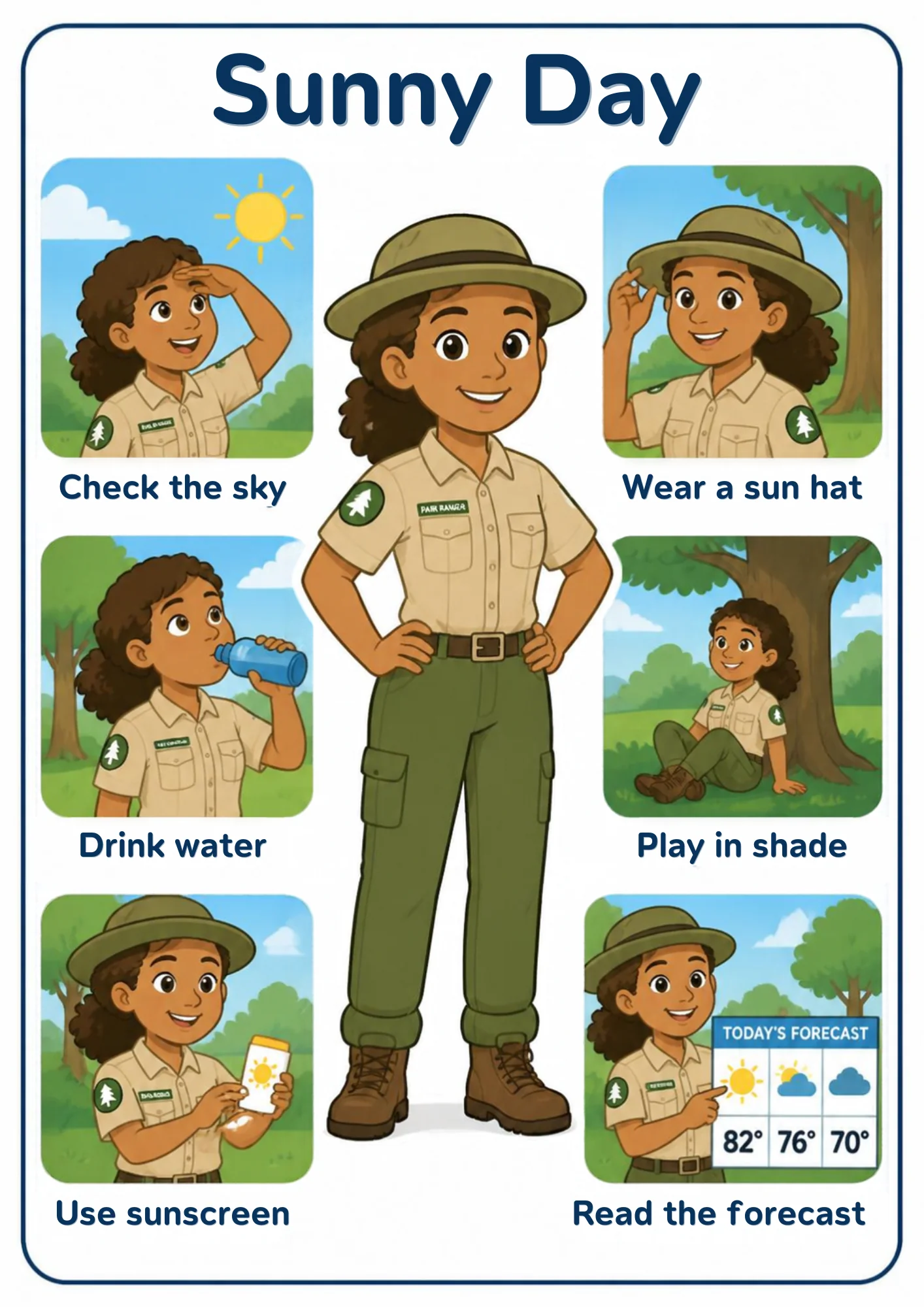
- Read the picture: the park ranger shades her eyes to check the sky, adjusts her wide hat, drinks from a water bottle, plays resting in the shade of a big tree, squeezes sunscreen onto her hand and points at a forecast board showing three days — sunny, partly cloudy, cloudy.
- Do the shadow check right now: jump — did your shadow jump? Stand still — did it freeze? The sun is the puppeteer.
- Run a shade hunt: find three cool resting spots in the garden or park, and name which one you would pick at midday.
- Build the routine into a chant: hat on, bottle filled, sunscreen by a grown-up — then out to play. Chant it at the door, every sunny morning.
Look closer at the picture
On this card a park ranger in a khaki hat and uniform: shades her eyes with one hand beneath a bright sun, adjusts her hat brim under a tree, drinks from a blue bottle, rests happily against a big shady trunk, squeezes sunscreen from a bottle with a yellow cap onto her arm, and points at a "Today’s Forecast" board with three columns — a sunny 82, a partly cloudy 76 and a cloudy 70.
Ask your child
"What does the sun do on a sunny day?" "When are our shadows longest — morning or midday?" "Where is the best shade spot?" "What goes in our sunny-day kit?"
What your child can say or do
Your child might say: "My shadow is longer than me now!" "Midday shade time — then back out to play," or recite the door chant unprompted: "Hat, bottle, sunscreen!"
Out in the real world
Track the family shadow on the walk to school across a whole week. Notice who else uses shade: dogs under benches, market stalls under canopies, cafés with umbrellas. Check the forecast board or app together and rate tomorrow’s sunny chances.
Try it together
Shadow circus: make your shadow into a rabbit, a giant, a crab — hands and feet tell the story. Shadow hopscotch: jump only on shady patches. Sundial snack: mark a biscuit-tin shadow with a stone at breakfast, check it again at lunch — the sun moved the shadow, and the snack tastes better outside anyway.
Understanding check
Ask: "What three things does a sunny day give us?" (Light, warmth, shadows.) "What do we do at midday?" (Shade and hats.) "What is in our sunny-day kit?" — Three routines named, one lesson landed.
Parent tips
Anchor the routine to the felt difference, not the lecture: one moment hatless in the sun, then hat on — "cooler, right?" The body remembers what the mouth explains. And never skip your own hat; the routine holds only if grown-ups visibly obey it too.
Staying safe
The midday sun is the strongest — shade rests and plenty of water in the peak hours, sunscreen applied by a grown-up before the day starts, never a stare upward, and never anyone left in a parked car, not even for one minute.
This lesson pairs with the Sunny Day flashcard in the library — print it, show it, keep it on the fridge. Back to Weather, Seasons & What We Wear (Class 34).