
Cloudy Day — a step-by-step lesson for grown-up and child
This lesson gives the cloudy day its due: what the grey ceiling really is, how the light and shadows change, and the perfectly-cool outdoor jobs — planting, watering, walking — that grey days are secretly best for.
What is this?
A cloudy day is when clouds cover most or all of the sky. The light turns soft and silvery, shadows fade to faint smudges, and the air often feels cooler because the sunshine is filtered through the cloud blankets.
What does it mean?
Cloudy does not automatically mean rainy — clouds have stages: a few white visitors, a half-grey sky, full grey cover, and the heavy dark kind that drips. Reading which stage the sky is in decides the day: coat, no coat, or umbrella in the bag.
What does the child need to know?
Your child needs three cloudy-day ideas: clouds filter the sun and soften the light; cloudy is not always rainy — we check which grey it is; and cloudy days are cool-work days, perfect for gardens and long walks.
Why this matters
The cloudy day teaches nuance — the sky has more than two settings. Grading the cloud cover (a bit, a lot, all of it) builds observation on a scale, and the reframe "grey days are garden days" widens a child’s idea of which days are good days.
What it teaches
Observation on a gradient, comparison vocabulary, the shadow experiment in reverse (soft light, faint shadows), care-of-plants routines, and emotional reframe practice — finding the good in a quietly grey day.
Words to learn
cloudygreysoft lightcoverdrizzlegardenmildgloomy
Say this to your child
“"The clouds have covered the sky like a big grey blanket. The sun is still up there, resting behind them. Cloudy days are cool and soft — the garden loves them, and so do gardeners. Let us check: is today a cloudy day or a rainy day?"”
Step by step
- Show the card: "A cloudy day is when the clouds pull their blankets over the whole sky."
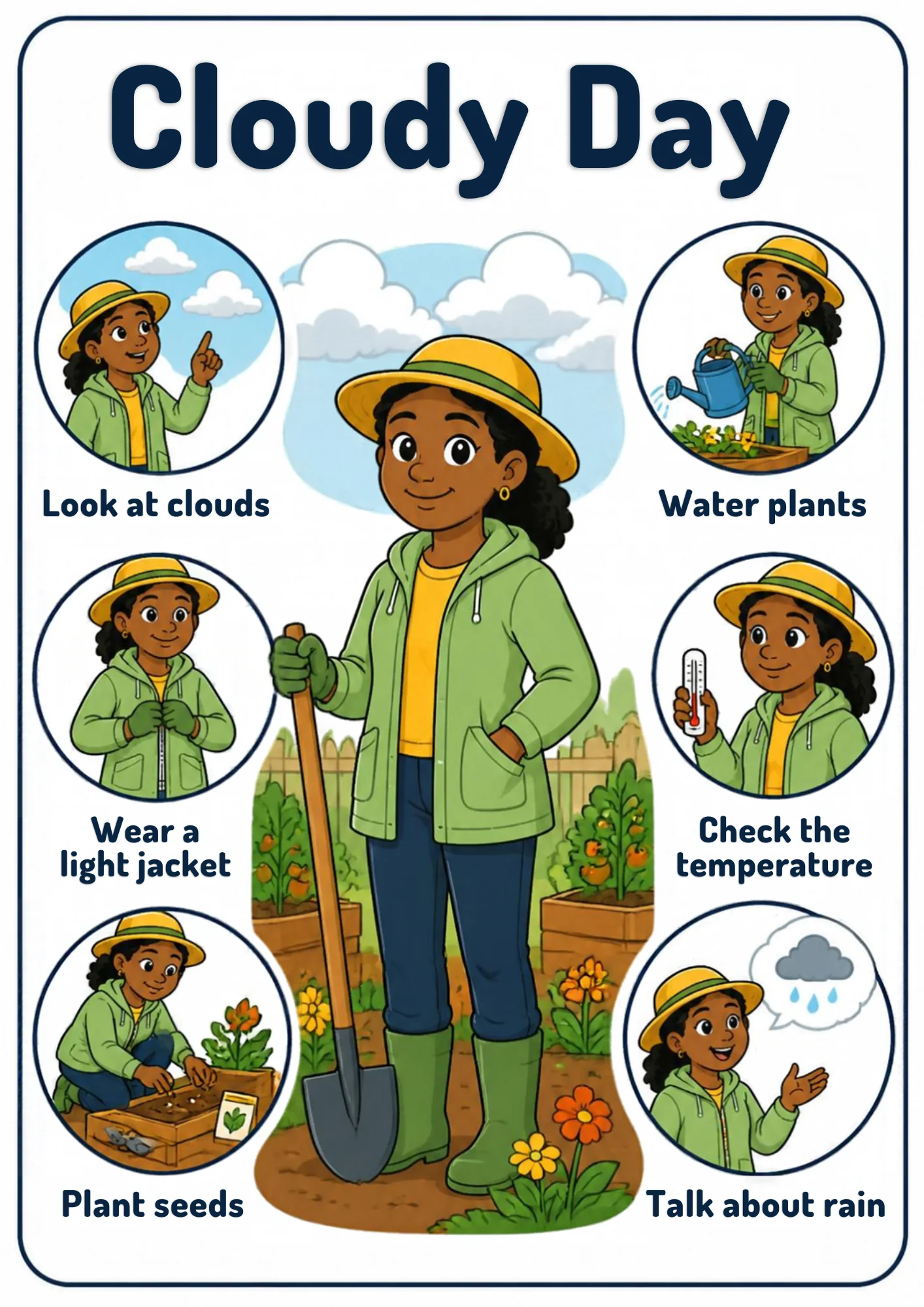
- Read the picture: the gardener in a yellow hat and green jacket stands with her spade under big grey-white clouds while the circles show her looking at clouds, watering plants, zipping a light jacket, holding a thermometer, planting seeds and talking about rain with a little rain cloud in her thought bubble.
- Grade today’s sky together: a few clouds, half covered, or all grey? Give the sky a cloud score from one to ten.
- Do the shadow check: on full cloud, shadows go faint — the sun’s light is arriving gently, from everywhere at once.
- Choose one grey-day job: watering the plants, planting seeds or a long cool walk — then go and do it, wellies standing by in case.
Look closer at the picture
On this card a gardener in a wide yellow hat, green jacket and green boots stands holding a spade in a garden with raised beds and a wooden fence, under a sky full of grey-white clouds. Around her in circles: she looks up at the clouds, waters flowers with a blue watering can, zips her light jacket, holds up a thermometer, plants seeds in a wooden tray, and talks about rain — a small rain cloud floats in her thought bubble.
Ask your child
"What do the clouds do to the sunshine today?" "Is a cloudy day always a rainy day?" "What happened to our shadows?" "What jobs are perfect for a grey day?"
What your child can say or do
Your child might say: "The sky has its grey blanket on!" "Shadows are hiding today," or the gardener’s report: "I watered the whole flower bed and I was not even hot."
Out in the real world
Compare feelings across weathers: what does the street look like on a cloudy day versus a sunny one? Notice the cool-work crowd — gardeners, dog walkers, builders — who get on with it happily under grey. Keep the daily cloud score going for a week.
Try it together
Grey-day picnic: the same blanket, the same sandwiches, just softer light — normalise outdoor joy under cloud. Play shadow-hide-and-seek: on a cloudy day nobody can see the seekers’ shadows, a genuinely different game. Then plant something — grey and cool is prime planting weather.
Understanding check
Ask: "What do clouds do to the light? Does cloudy always mean rainy? Name one perfect cloudy-day job." Soft light, not always, and any honest garden answer — the grey day is now a good day.
Parent tips
Watch your own weather talk: children hear everything, and "grey old day" teaches grey means gloomy. Try "soft day" or "good garden weather" and let the reframe do quiet work. And keep the jacket rule honest — cloudy air is often cooler than it looks.
Staying safe
Grey skies still let sun through — for long midday outings, the hat stays in the bag and on the head. And check whether the grey is heading for rain: a heavy, darkening sky means the coat — maybe the umbrella — comes along too.
This lesson pairs with the Cloudy Day flashcard in the library — print it, show it, keep it on the fridge. Back to Weather, Seasons & What We Wear (Class 34).