
Donkey — a step-by-step lesson for grown-up and child
This lesson hands your toddler the deck’s comedy crown: hee-haw, sung slowly, sung fast, sung gloomy — a one-sound song that teaches how words are built from bits.
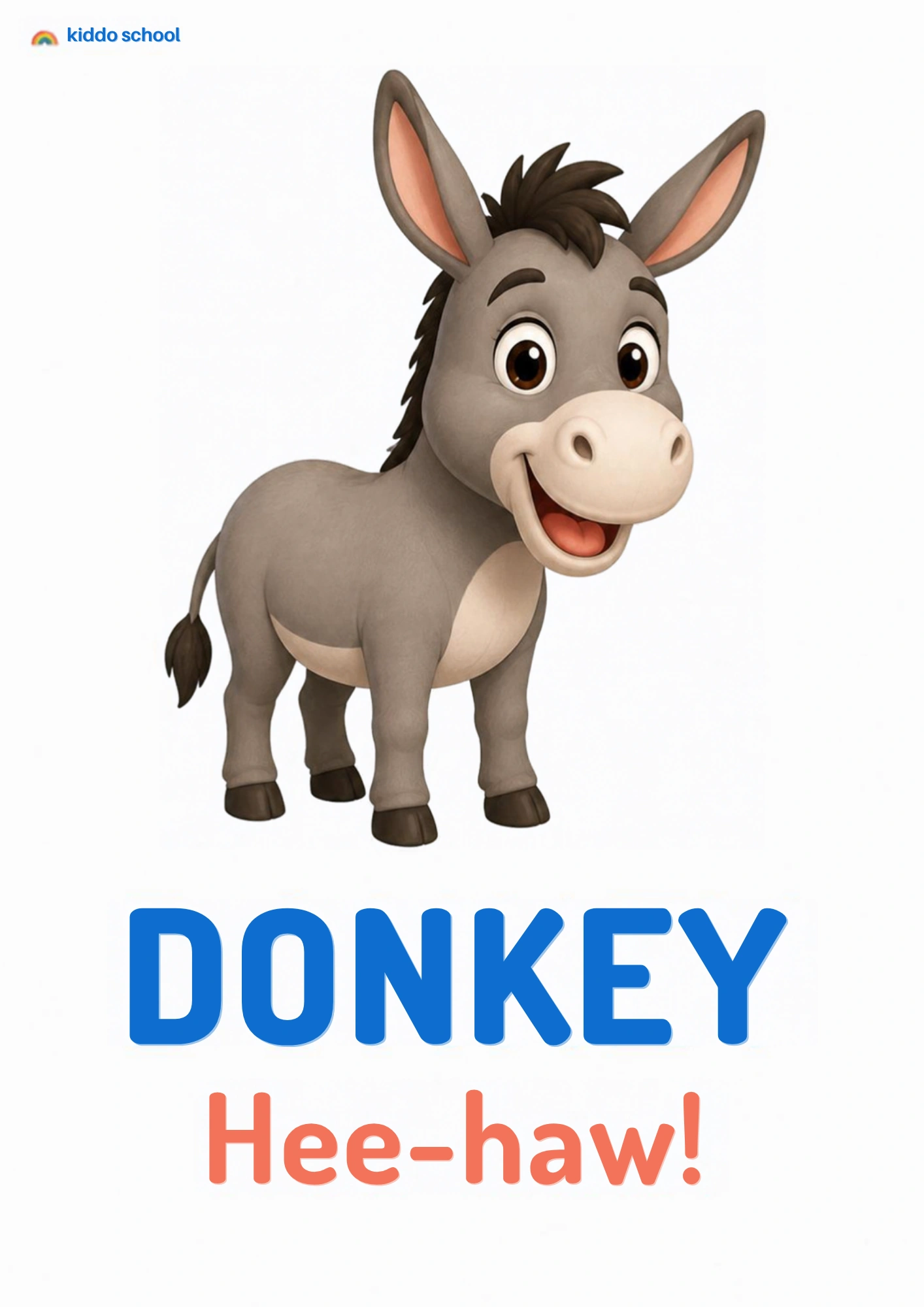
What is this?
A donkey is a long-eared farm animal that says hee-haw — a two-part bray that starts high and ends low, which is why it sounds so gloriously wrong.
What does it mean?
Hee-haw is high-low in one breath: your toddler is singing an interval without knowing it. Two-part sounds teach that noises have shape, the seed of all later speech melody.
What does the child need to know?
Deliver it slow and gloomy at least once — the droopy version is reliably the one that lands the laugh. Nobody is more delighted by the silliness than the toddler.
Why this matters
One sound, many performances: hee-haw teaches a toddler that a noise can be stretched, shuffled and staged — the discovery that words are built from parts.
What it teaches
Pitch play from high to low, song-building with a single syllable pair, and comic timing — the first jokes toddlers tell are sound jokes they control.
Words to learn
donkeyhee-hawfunnylongearssong
Say this to your child
“"A donkey! Hee-haw! Can you say it? Hee — haw! Now slowly… heeeee… haaaaaw. The donkey owns the silliest noise on the whole farm, and very, very long ears."”
Step by step
- Show the card and say donkey, then hee-haw — high on hee, low on haw, with the long ears drooping.
- Sing it three ways together: fast hee-haw, slow hee-haw, and the gloomy one that ends in a sigh.
- Invent a hee-haw song where every verse finishes with the bray — any farm tune you half-remember will carry it.
- When your toddler invents a new way to say it — extra haws, double hees — adopt their version immediately; their composition is the milestone.
- Assign hee-haw its jobs this week: it opens the toy box, it greets the bath, it finishes the bedtime book.
Look closer at the picture
The card shows a donkey saying hee-haw. Find the donkey, find the hee-haw, then ask where the donkey’s ears are — long ears are this card’s best detail.
Ask your child
"Where is the donkey?" "What does the donkey say?" "Can you say it slow and gloomy?" "Can you make up a hee-haw song?"
What your child can say or do
"Hee-HAW!" with a droopy face, or a haw that arrives without the hee — take it. Some toddlers will hee-haw every animal for a day; the donkey’s fame is brief and glorious.
Out in the real world
Donkeys appear at farms, on the beach in some towns, and in every nursery-song book. The beach or paddock version gets the loudest toddler hee-haw on record.
Try it together
Hee-haw choir: every family member picks a different hee-haw speed and you sing them in order — fast, slow, gloomy, sleepy. Your toddler conducts and chooses which comes next.
Understanding check
Ask what the donkey says. Any hee, haw or haw-hee passes. The real test is the invented variation — a hee-hee-haw or a sung-gloomy haw means sound play has gone creative.
Parent tips
Match their tempo once, then offer one alternative — fast after slow, quiet after loud. The contrast is what keeps a one-sound game alive past the third day.
Staying safe
Farm donkeys look soft and are stronger than they act — feed nothing, stroke nothing without the farmer’s yes, and keep fingers away from those long, curious lips.
This lesson pairs with the Donkey flashcard in the library — print it, show it, keep it on the fridge. Back to Animals & Sounds (Toddler 5).