
Bee — a step-by-step lesson for grown-up and child
This lesson starts the garden with its busiest worker: your toddler learns the word bee, makes the buzzy sound, and meets the golden rule that holds the whole set together — eyes do the visiting, hands stay down.
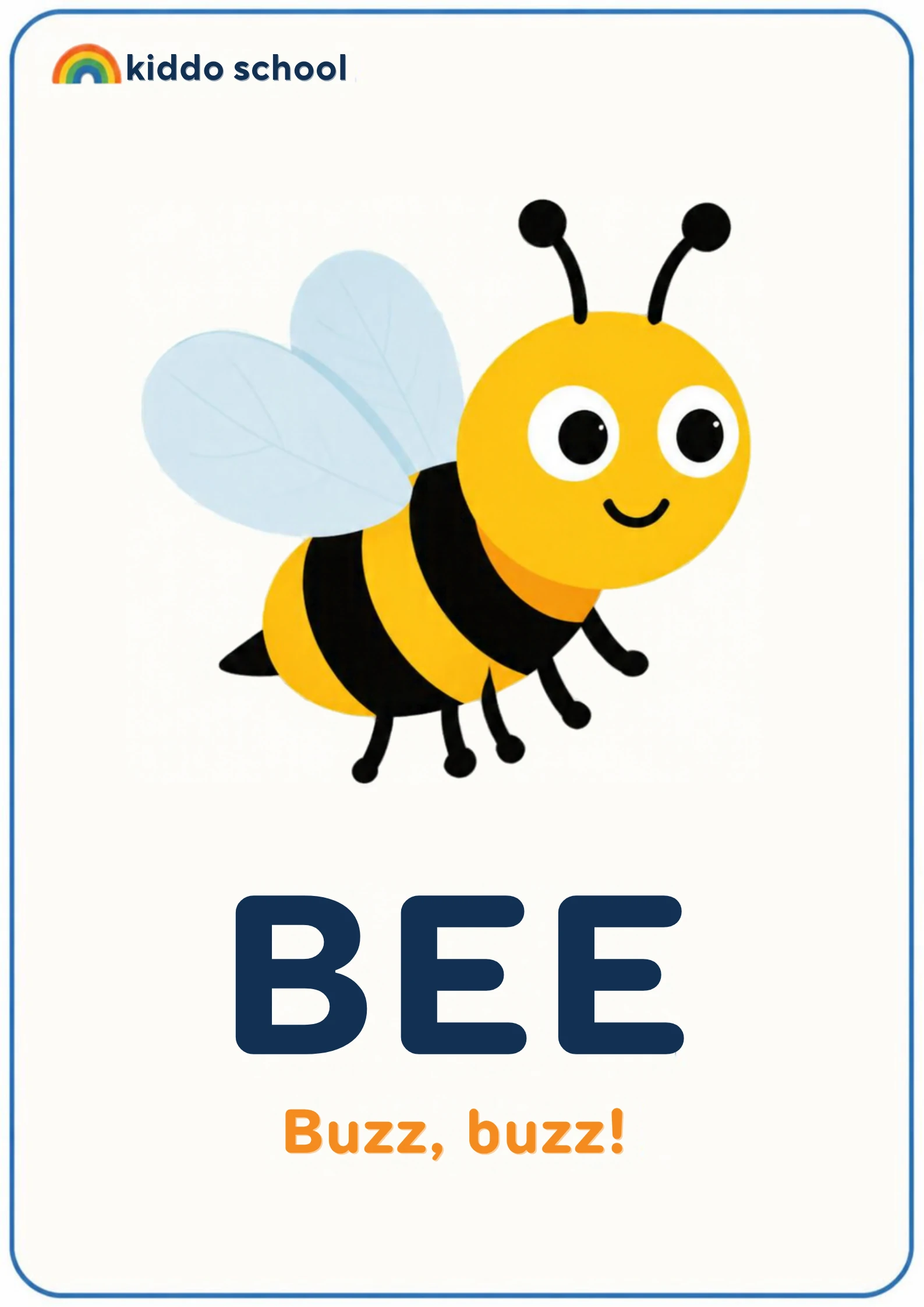
What is this?
A bee is a small flying insect with yellow and black stripes that visits flowers to gather pollen and make honey. Bees spend the whole day travelling from bloom to bloom — the garden’s own delivery service.
What does it mean?
The bee is the loudest hello in the garden and usually the first bug a toddler can already point at. Naming it properly turns a random buzz into a friend greeted by name — and the bee carries the set’s most important rule on its stripes.
What does the child need to know?
Two things matter: bees say bzzz and visit flowers all day long, and we watch them without touching. Bees are busy workers, not pettable pets — calm eyes and down-held hands are how we say hello.
Why this matters
Look-don’t-grab is easiest to learn from a bee, because the reason is built into everyday life: everyone already treats bees with respect. Your toddler practises the rule exactly where the whole family already follows it.
What it teaches
First-insect vocabulary, sound imitation (bzzz is a lifelong favourite), watching-without-touching — genuine impulse practice — and the early idea that living things have jobs to do.
Words to learn
beebuzzflowersstripeshoneygentle
Say this to your child
“"Here is the bee! Bzzz... can you say bzzz? The bee wears stripes and it loves flowers. When we see a real bee, we stand still like trees and watch — no grabbing, no squealing. Bees are busy, and our job is to watch them work."”
Step by step
- Show the card and say bee slowly, twice — then add a long buzzy bzzz together, so the word arrives with its sound.
- Ask your toddler to find the bee’s smile and trace its stripes with one finger — the picture study that two-year-olds do best.
- Make your hand a little bee and fly it around the room, touching down softly on cushions and shoulders — soft landings only, bees are careful pilots.
- Look out of a window at any flowers and whisper: is a bee visiting right now? Maybe, maybe not — the looking is the game.
- End with the rule in toddler words: bees are watch-friends. We look, we buzz, and our hands stay down by our sides.
Look closer at the picture
Say bee together and give the card a big buzzy bzzz. The bee on this card is friendly and smiling — ask your toddler to find its smile and point at the stripes. Pointing is how two-year-olds study a picture.
Ask your child
"What does the bee say?" "Can you find the stripes?" "Where does the bee go all day?" "Do our hands touch the bee, or stay down?" — answered with a buzz, a point and a solemn little nod.
What your child can say or do
"Bzzz!" delivered at full volume, hand-bees circling your head at breakfast, and bees pointed out in books, on rugs, out of prams. Some toddlers will freeze into their best statue pose at the first real buzz — the rule already working.
Out in the real world
Bees appear wherever flowers do — window boxes, balconies, the lawn, the herb pot on the sill. Every real buzz is a rerun: whisper bee, keep feet still, watch it work, wave it goodbye.
Try it together
Bumble landing: your toddler flies around as the bee while you hold up a cushion-flower. Touching down softly on the flower scores a cheer; bumpy crashes get a gentle reminder that careful bees make the best honey.
Understanding check
Next time a bee flies past outside, watch the hands: if they stay down and the mouth whispers bee, the lesson landed — watching replaced grabbing, which was the whole point.
Parent tips
Practise the statue pose on the card first, when no bee is anywhere near — calm is rehearsed best in peacetime. Keep sessions short: one buzz, one point, one rule, done.
Staying safe
Bees sting when they feel squashed or trapped, so the looking happens from a little way back and hands stay far away. If one lands close by, still feet and a quiet voice until it lifts off — and a grown-up guides the moment, never a swatting hand.
This lesson pairs with the Bee flashcard in the library — print it, show it, keep it on the fridge. Back to Garden Bugs & Friends (Toddler 8).