
Elephant — a step-by-step lesson for grown-up and child
This lesson stomps: your child hears the eh sound hiding twice inside one enormous word, swings an arm like a trunk, and traces a letter built from straight lines and shelves.
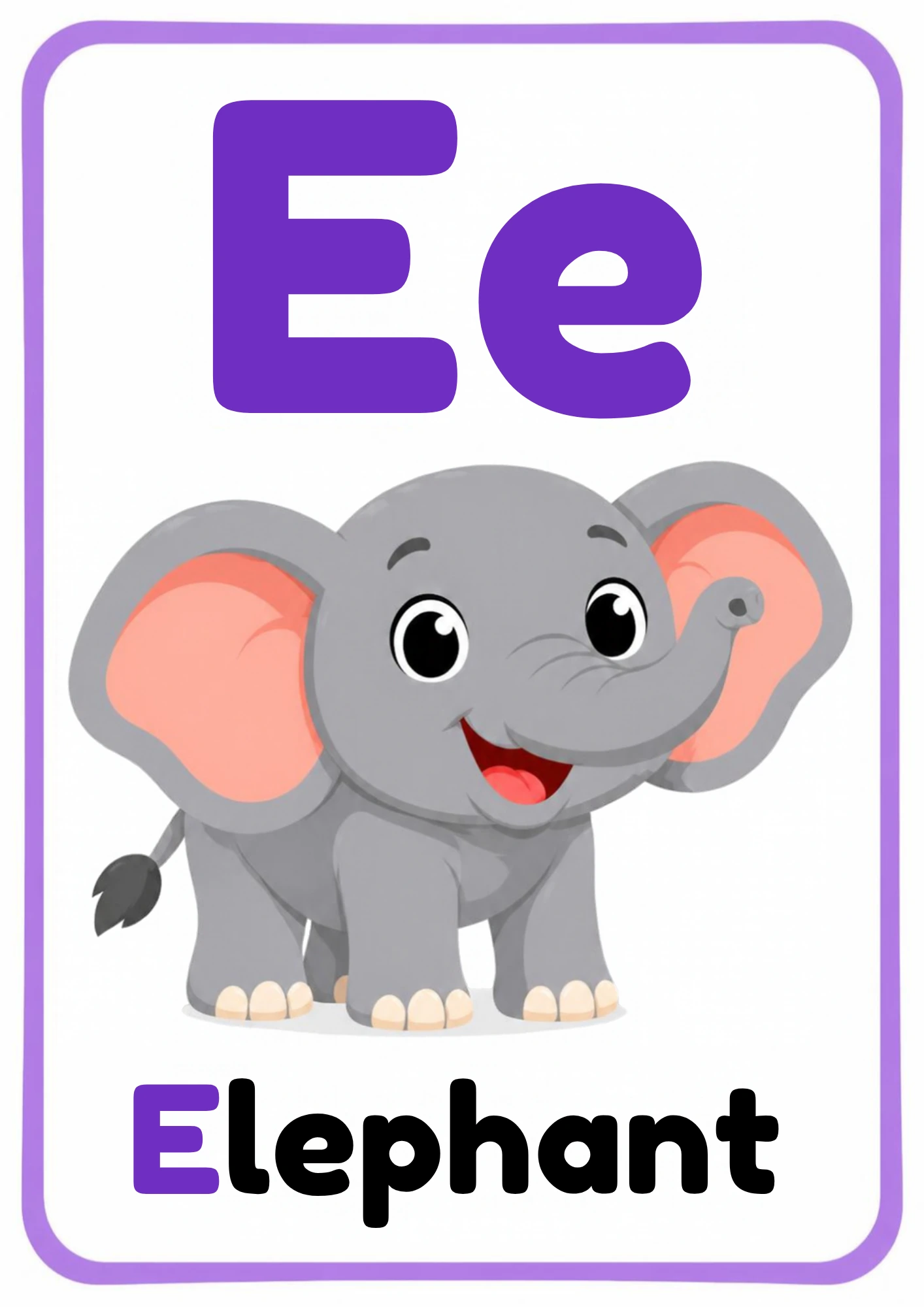
What is this?
E is the fifth letter of the alphabet. In elephant, it makes its short sound: eh — the sound at the start of egg and elbow. Stretch the word out — eh-leh-fant — and the sound turns up twice.
What does it mean?
Elephant is a long word wrapped around a short sound, and children love the contrast: the littlest-looking letter in front of the biggest animal on the card. Contrast like that is a memory hook.
What does the child need to know?
The letter is called E; in elephant it says eh — mouth relaxed, barely open, a short flat sound. E has other sounds waiting in later years, but today one honest eh is the whole portion.
Why this matters
A word your child can hear the sound in twice doubles the practice inside a single word. And a giant animal makes the smallest letter on the card impossible to ignore.
What it teaches
Short-vowel sound isolation, syllable stomping (three stomps for eh-leh-fant), letter recognition in two cases, whole-body slow movement, and the early idea that one letter can work twice in one word.
Words to learn
Eelephantehsoundtrunkstomp
Say this to your child
“"This is the letter E — hello, E! And this is an elephant. Listen for the eh hiding inside: eh-leh-fant. Can you hear it twice? Make the sound with me — eh! Now swing your trunk and stomp: eh, eh, elephant. Slow and giant, just like a real one. Then trace the big E for me — down, shelf, shelf, shelf."”
Step by step
- Show the card and let the size land first: this is the letter E, and this is an elephant — a very big animal with a very small sound.
- Make the sound: eh — mouth relaxed, barely open, like the little shrug-sound in eh-oh. Try eh three times, then stretch the word: eh-leh-fant.
- Trace big E with one finger — one straight back, then three shelves — and little e: a small curve with a shelf tucked across its middle.
- March like an elephant: slow heavy steps, one arm swinging like a trunk, one eh for every stomp. Elephants never hurry, and neither does this letter.
- Close with an eh-hunt: find two things whose names start with eh — an egg from the fridge, an elbow, the edge of a rug — and stomp once for each.
Look closer at the picture
Find the big uppercase E and the little lowercase e on the card, then the elephant and the word Elephant. Ask which letter holds more shelves — big E stacks three, little e keeps one tucked in its curve.
Ask your child
"What is this letter called?" "What does E say in elephant?" "How many times can you hear eh in eh-leh-fant?" "Can you take one giant elephant step?" — answered with a name, a short eh, two happy discoveries and one floor-shaking stomp.
What your child can say or do
"Eh! Eh-elephant!" Expect trunk-arms at breakfast, eh-sounds offered for eggs and elbows, and very slow crossings of the living room. Elephant may become the preferred way to walk anywhere. The stomping is the lesson working.
Out in the real world
E waits quietly in a child’s day: egg, elbow, edge, elephant at the zoo, exit signs on doors. Every eh you spot together is a rerun of the card — name it, sound it, stomp on by.
Try it together
Elephant steps: lay three cushions or paper spots on the floor and cross them with slow giant steps, one eh per step. Add a trunk-arm challenge at the far end — pick up a small toy, elephant-style, and carry it back.
Understanding check
Ask tomorrow what E says in elephant: a short flat eh means the sound landed. Little e traced in the air — curve first, then shelf — completes the letter.
Parent tips
One sound per letter is the rule at this age: eh is today’s whole serving, and E’s name-sound can wait politely for another year. If the march grows too lively, shrink it to trunk-arms only and keep the feet still.
Staying safe
Elephant marching needs clear floor and slow feet — the whole point is heaviness, not speed. Cushion-hopping stays low and supervised, and stomping pauses whenever anyone smaller than an elephant is underfoot.
This lesson pairs with the Elephant flashcard in the library — print it, show it, keep it on the fridge. Back to Alphabet A–Z (Preschool).