
Fish — a step-by-step lesson for grown-up and child
This lesson breathes: your child rests top teeth on a bottom lip, lets the air slide out in a clean fff, blows a feather across the table and traces the letter with the tidy shelves.
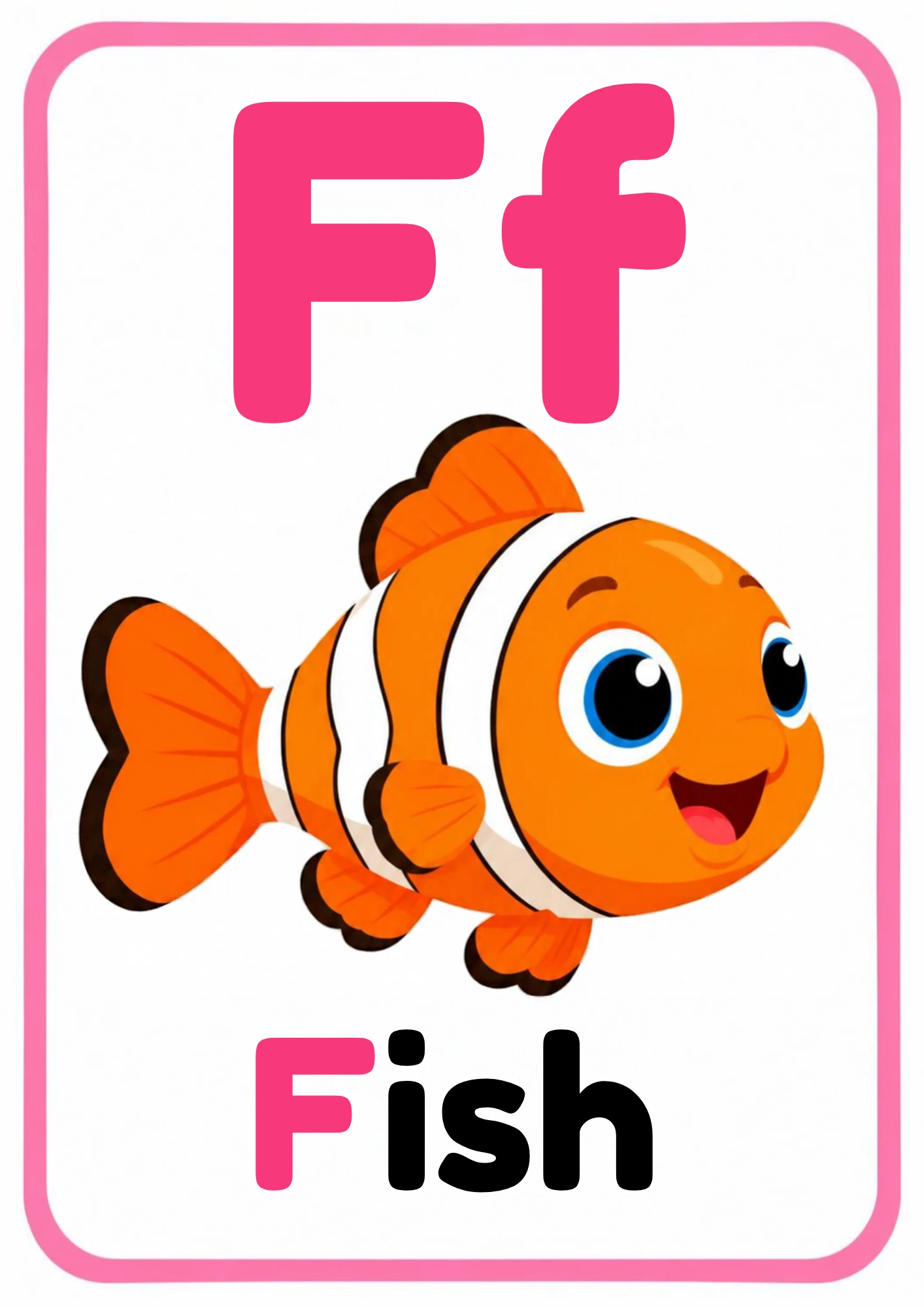
What is this?
F is the sixth letter of the alphabet. Big F and little f make the f sound — a windy whisper made with the top teeth resting on the bottom lip while the air slides out. No voice, just wind.
What does it mean?
F is the first soundless sound in the set: nothing buzzes, only air moves. Feeling that quiet — wind with no voice behind it — is real phonemic awareness your child can hold in one long breath.
What does the child need to know?
The letter is called F; the sound is fff, long and soft. If a buzz sneaks in, the voice has switched on and v has borrowed the mouth — quiet air means F is being said correctly.
Why this matters
A sound your child can see working in a dancing tissue checks itself: wind moves the tissue, buzzing does not. The fish just supplies the swimming story that keeps everyone playing.
What it teaches
Lip-teeth placement awareness, voice-off versus voice-on discrimination, breath length control, letter recognition in two cases, and the finger isolation needed for tracing — all inside one quiet game.
Words to learn
Ffishfffwindblowquiet
Say this to your child
“"This is the letter F — hello, F! F says fff, like wind slipping out. Teeth on your lip, then blow: fff. Feel it? No voice, just air — the quietest sound in the alphabet. Now we swim: fff, fff, fish! And trace the big F with me — down, shelf, shelf — like a flagpole with two little flags."”
Step by step
- Show the card and make the introductions: this is the letter F, and this is a fish — the quietest animal in the whole alphabet set.
- Make the sound: top teeth rest on the bottom lip and the air slides out — fff. Hold your throat and notice the quiet: no buzz, only wind.
- Trace big F — one tall line down, then two shelves across the top — and little f: a tall line with a small hook at the top and one crossbar.
- Play the wind game: lay a feather or tissue on the table and move it along with fff puffs — long wind, short wind, then a racing wind.
- End with an f-hunt: find three things whose names start with fff — a finger, a foot, a picture of a frog — and blow a little fff at each one.
Look closer at the picture
Find the big uppercase F and the little lowercase f on the card, then the fish and the word Fish. Ask which letter carries more shelves — big F has two crossbars, little f wears just one.
Ask your child
"What is this letter called?" "What sound does F make?" "Can you feel the wind with no buzz in it?" "What f-words can we blow toward in this room?" — answered with a name, an airy fff, a quiet throat and a wandering finger.
What your child can say or do
"Fff! Fff-fish!" Expect lip-teeth experiments at dinner, fff-puffs at candles and dandelions, and wind sounds aimed at everything light enough to move. A quietly blowy child is F’s favourite souvenir.
Out in the real world
F floats through the day: fork, flower, foot, fish fingers, the four on the clock. Every fff is one breath long — spot it, say it, and let the air do the teaching.
Try it together
Feather race: two players blow a feather or a small paper ball across the table toward each other, every push released as fff. Longest wind wins, not loudest — and the fish card referees from the side.
Understanding check
Ask what F says: a long soft fff with the teeth finding the lip means the sound landed. A throat-check with no buzz seals it — quiet air, correct letter.
Parent tips
If fff buzzes into vvv, hold your own throat and compare out loud — the quiet one is F — then keep playing; the distinction arrives through feeling, not correction. Wind games stay gentle and well away from eyes.
Staying safe
Feathers, tissues and small paper balls stay out of mouths and away from eyes — blowing only, never sucking. Keep puff-play off tables with breakables, and park the game before anyone gets too breathless to laugh.
This lesson pairs with the Fish flashcard in the library — print it, show it, keep it on the fridge. Back to Alphabet A–Z (Preschool).