
Whale — a step-by-step lesson for grown-up and child
This lesson surfaces: your child rounds their lips into a little circle for wuh, crouches small and rises like a whale spouting, and traces the letter that looks like two valleys.
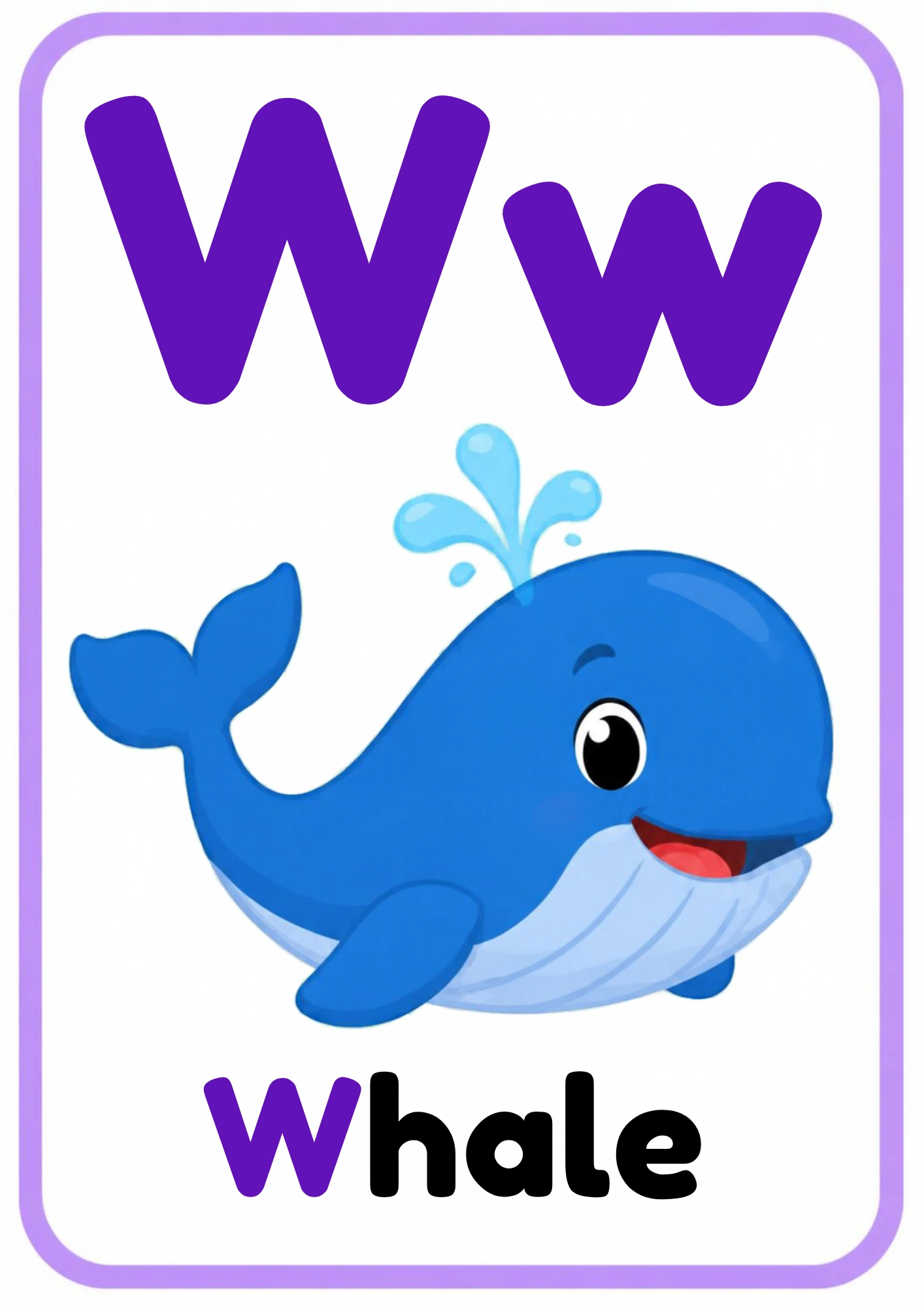
What is this?
W is the twenty-third letter of the alphabet. Big W and little w make the w sound — wuh, made by rounding your lips into a small circle, like blowing a kiss and talking at once.
What does it mean?
W is the only sound with a lip-shape this round, which makes it visible from across the room: watch for the fish-mouth. The whale spout then gives the sound a whole body to rise through.
What does the child need to know?
The letter is called W; the sound is wuh — round lips, quick and smooth. The name looks like double-u, and in several languages it is exactly that; whichever name keeps your child talking about whales is the right one.
Why this matters
A rise-from-the-floor game turns the sound into a wave: curl, whooo, spout, splash. And whales are the giants of every animal book, so the card arrives with respect already attached.
What it teaches
Round-lip sound production, breath rising with whole-body movement, letter recognition in two cases, crouch-and-rise core strength, and pretend water play that builds ocean vocabulary alongside.
Words to learn
Wwhalewuhroundspoutsplash
Say this to your child
“"This is the letter W — hello, W! W says wuh — round your lips into a little circle, then let the sound out: wuh! Kissy-lips with a voice. Now be a whale: curl down small... rise up slow... whooo... and SPLASH, the spout goes up! Then trace the big W: down, up, down, up."”
Step by step
- Show the card and dive in: this is the letter W, and this is a whale — the biggest animal the alphabet knows.
- Make the sound: round your lips into a small circle — wuh, a gentle kiss with a voice behind it. Try wuh three times, then wuh-whale.
- Trace big W — down, up, down, up: two valleys side by side — and little w: the same two valleys, smaller.
- Play the spout: curl down small like a whale underwater, rise up slowly saying whooo, then throw your arms up as the water sprays — splash!
- End with a w-hunt: find three things that start with the round-lip sound — a window, some water, somebody’s wrist — and round your lips at each.
Look closer at the picture
Find the big uppercase W and the little lowercase w on the card, then the whale and the word Whale. Ask what shape the letters make — two dips like waves, one after the other, rolling across the card.
Ask your child
"What is this letter called?" "What sound does W make?" "Can you show me the round lips?" "How big was your whale spout this time?" — answered with a name, a round wuh, a fish-mouth and two arms full of imaginary water.
What your child can say or do
"Wuh! Wuh-whale!" Expect kissy-lips at bath time, w-sounds offered to water and windows, and spout-jumping wherever floor space allows. Rising whales may appear from every crouch. Bath time becomes the best classroom in the house.
Out in the real world
W washes through the day: water, window, wellington boots, weekend. Every round-lipped wuh is the card surfacing — and every whale in a picture book is the spout game waiting for its next performance.
Try it together
Whale rise: crouch on the floor, rise on a long whooo and sink back down with a splash — five rises is a full whale morning. Add a shallow bowl of real water for fingertip dips only, one drop per spout.
Understanding check
Ask what W says: a smooth round-lip wuh means the sound landed — watch for the fish-mouth to be sure. A wiggly little w traced in the air, two valleys deep, completes the ocean.
Parent tips
If the lips stay flat, model the kissy-circle in a mirror without saying anything — the shape teaches itself. Double-u or wuh: let your child use whichever name keeps them talking about whales.
Staying safe
Whale rises need headroom and clear floor — spouting arms steer around lamps and siblings. Real water play stays a shallow fingertip splash with a towel ready, and crouching whales surface before their legs fall asleep.
This lesson pairs with the Whale flashcard in the library — print it, show it, keep it on the fridge. Back to Alphabet A–Z (Preschool).