
Frog — a step-by-step lesson for grown-up and child
This lesson takes a running hop at the smallest far-jumper in the collection. Ribbit is short and bouncy — one bounce per syllable — and the frog on the card brings the best transformation story going: from tadpole to hop.
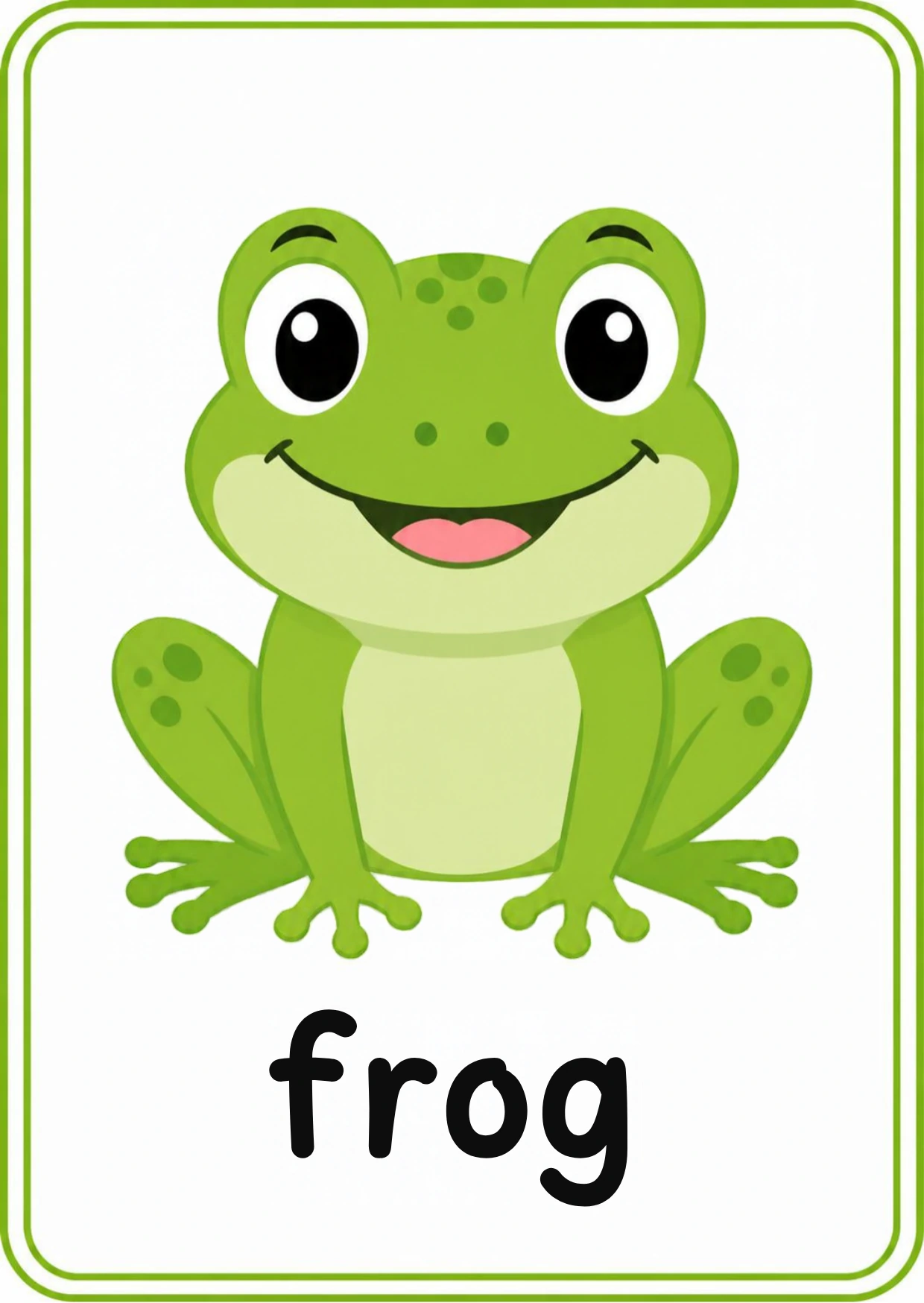
What is this?
A frog is a small green jumper that lives near water, catching bugs with a tongue quicker than a blink. Its call is a short bouncy croak, and people copied the most famous version as ribbit — a word with a hop built into every syllable.
What does it mean?
Ribbit is our copy of one kind of frog — and different frogs croak differently all over the world, which makes ribbit the local accent of frog. What every version shares is the bounce: the sound and the hop arrive together, as if the call itself were jumping.
What does the child need to know?
Your child needs to know: the frog’s sound is written ribbit in English, frogs hop instead of walk, they catch bugs with a sticky tongue, and they grow up in the water — starting as tadpoles, tiny swimming dots, before legs arrive and the hopping starts.
Why this matters
The frog carries the set’s best growing-up story: egg, tadpole, frog. It is transformation a child can follow start to finish, and it quietly teaches that babies can look nothing like their parents — a fact your child will later recognize in butterflies, and, in small ways, in themselves.
What it teaches
Gross-motor hopping and landing, the tadpole-to-frog sequence, imitation of a staccato sound, pond-life vocabulary, and patience — the transformation takes months, which is a long time by three-year-old measures.
Words to learn
frogribbithoppondcroaktadpole
Say this to your child
“"The frog says ribbit! Ribbit, ribbit — one hop for every ribbit! Ribbit is our copy of the frog’s call, and frogs croak it all around the world, each pond with its own accent. Before the hopping, the frog was a tadpole — a tiny swimmer with a tail. Wiggle, wiggle… legs! Hop, hop, RIBBIT!"”
Step by step
- Show the card and ask what the green jumper says. Then demonstrate: ribbit, ribbit — with a hop on each one.
- Say the pair — the frog says ribbit — and keep the bounce rule: no ribbit without a hop. Sound and jump, locked together.
- Look at the picture: a green frog sitting on its front legs, folded and ready. Fold yourself into the same shape — squat low, hands down, coiled like a spring.
- Tell the growing story: frog eggs hatch into tadpoles that swim like tiny fish, then legs grow, the tail shrinks away, and one day the pond has a jumper. Act it: wiggle small, then hop big.
- Hold a hop-and-ribbit race across the rug: one hop, one ribbit, all the way. Frogs rest between jumps — so do racers.
Look closer at the picture
Look at the picture together: what color is the frog? Where are its front legs — is it sitting on them? What word sits with the frog? Do its back legs look ready to jump?
Ask your child
"What does the frog say?" "What was the frog before it was a frog?" "How does a frog move — walking or hopping?" "What does a frog eat, and how does its tongue help?"
What your child can say or do
Your child may ribbit-hop the entire length of the hallway, explain the tadpole story in reverse to a confused teddy, or crouch folded like the card and wait, coiled, for someone to say go — the shape, sound and story all jumped into one.
Out in the real world
Frogs live at ponds, streams and damp gardens — and after spring rain, the whole neighbourhood croaks. A puddle-side visit at dusk is the real-life soundtrack; frogspawn in a pond in spring is the growing story happening live.
Try it together
Tadpole-to-frog transformation: start curled and wiggling on the floor — egg, then tadpole, swimming tiny circles. Then legs! Hop up, ribbit, and you are frogs. Run it slowly with narration, then speed it up until the transformation takes three seconds and everyone collapses laughing.
Understanding check
Ask: "What does the frog say? What was it before? Show me a hop with a ribbit." The bounce, the tadpole and one springy jump — that is the lesson landed.
Parent tips
The no-hop-no-ribbit rule is what makes the game — it fuses sound to movement and doubles the exercise. If real frogs appear at the pond, watch from the bank: frogs’ skins are delicate, and the best frog is an observed frog.
Staying safe
Pond banks are slippery and frog hunts stay on the dry side of the edge — small frogs get looked at, gently, and hands get washed after any pond touching.
This lesson pairs with the Frog flashcard in the library — print it, show it, keep it on the fridge. Back to Animals & Their Sounds.