
Rainbow — a step-by-step lesson for grown-up and child
The rainbow closes the set the way it closes a storm: with everything at once. This lesson is the graduation — every color your child has learned, marching together in line, in one splash and one sky.
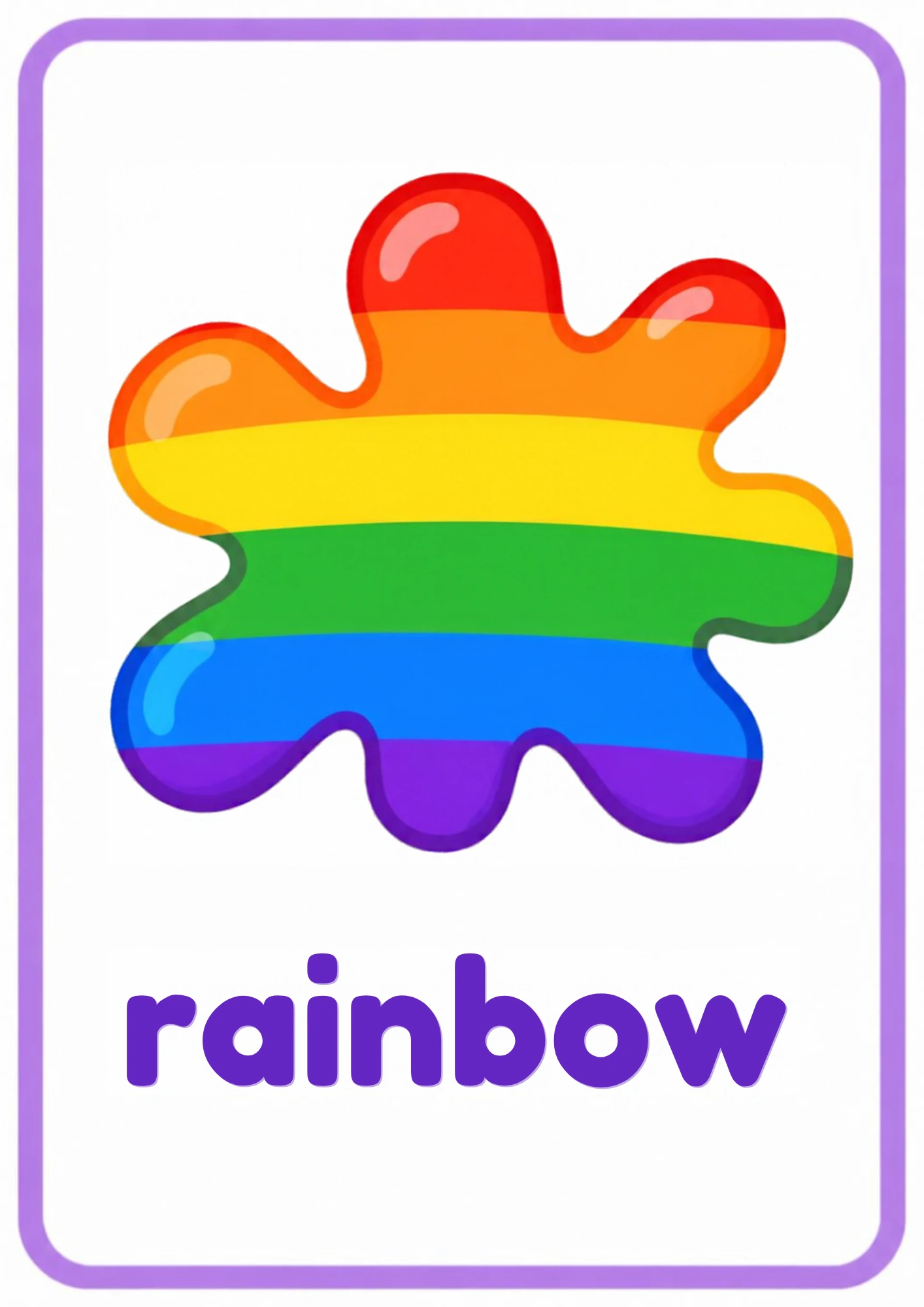
What is this?
A rainbow is the arc of colors that sometimes appears in the sky when sun meets rain: red, then orange, then yellow, then green, then blue, then purple — always that exact order. The splash card shows the colors flowing together in one splash; the picture card shows a real rainbow arched across the sky. Both wear the word rainbow.
What does it mean?
The rainbow is color knowledge made visible as one thing: six words your child owns, joined into an arc they can now name in order. Reciting a sequence — and knowing there IS an order — is early maths wearing a sky: it is the same skill as counting, and it will not stay inside rainbows.
What does the child need to know?
Your child needs all six colors named at the splash, one recitation with pointing, and one drawn rainbow — half a dozen crayons, six arcs, whatever paper is at hand. A true rainbow asks for sunshine and shower together, so the spotting is a patience game: a rainbow drawn from memory counts just as much as a find, and the sky will deliver the real thing someday, unannounced.
Why this matters
Sequencing is the quiet prize here: saying colors in order is ordering, and ordering is the front door to counting, alphabet and taking turns. The rainbow packages that skill in the most beautiful object in the set — which is why it goes last, when every color in it is already known.
What it teaches
Sequencing and order (six colors, fixed positions), recall of the whole set, drawing with intent (six arcs, chosen colors), patience for rare real-world events, and the graduation pride of finishing a whole class.
Words to learn
rainbowcolorsarcorderskyname
Say this to your child
““A rainbow! Every color we know, all in one place. Red, then orange, then yellow, then green, then blue, then purple — say each one as I point. That is their order; rainbows always keep it. Now let us draw one — every color gets a turn, in a big arch across the paper!””
Step by step
- Show the splash card and name the colors as you point: red first, then orange, yellow after that, green, blue, and purple bringing up the rear — slowly, in order.
- Say them again as one run, singing if you can, while your child points at each color in turn on the card.
- Turn to the picture card: a real rainbow arched across the sky. Ask which of the six colors your child can find on it.
- Draw one together: choose six crayons and lay down six arcs across whatever paper you have, naming each color as it takes its turn.
- Hang the drawing where the weather can be watched from, and keep the patience game open: a real rainbow is coming someday, and your child will be the first to shout.
Look closer at the picture
Both cards together now: the splash card is one big splash striped with every rainbow color and the word rainbow on it, and the picture card shows a real rainbow arched across the sky with the word too. Ask your child to find red on both, then blue on both — the order holds on each card.
Ask your child
“What comes after red in a rainbow?” “What does a rainbow need — what kind of day?” “Can you point at the top of the arc?” “Which color is your favorite today?”
What your child can say or do
Your child might sing the color run at random moments, check the sky after every rain shower for weeks, or correct your drawing when blue jumps the queue — an ordered sequence defended is a sequence truly learned.
Out in the real world
Rainbows keep a low schedule, but their colors rehearse daily: red cars, orange cones, yellow ducks, green grass, blue bins, purple flowers. The set has taught the parts; the world keeps offering the whole — and one real rainbow collects them all at once.
Try it together
Color-line parade: six papers or toys in rainbow order across the floor, and your child marches the arc from red to purple, naming each as they pass. Reverse it for the encore — going backwards is harder, funnier, and the real test of the sequence.
Understanding check
Ask: “Name the rainbow colors in order. What do we need besides rain? Show me the top of the arc.” Six colors recited, sun-plus-rain remembered and a finger at the sky — that is the whole class, landed.
Parent tips
If your child asks what makes a rainbow, keep it honest and small: sun shining through raindrops makes the colors stand up in an arc. The full physics can wait; the wonder cannot, so protect it and let the sky keep its trick.
This lesson pairs with the Rainbow flashcard in the library — print it, show it, keep it on the fridge. Back to Colors & Color Mixing (Preschool).