
Pineapple — a step-by-step lesson for grown-up and child
The pineapple is the fruit bowl’s royalty: a golden body under armor, wearing a green crown, hiding a secret — it grows in the ground, not in trees, crown or no crown. This lesson teaches the word at the card, the secret, and the touch test that makes the bumpy-skin comparison unforgettable.
What is this?
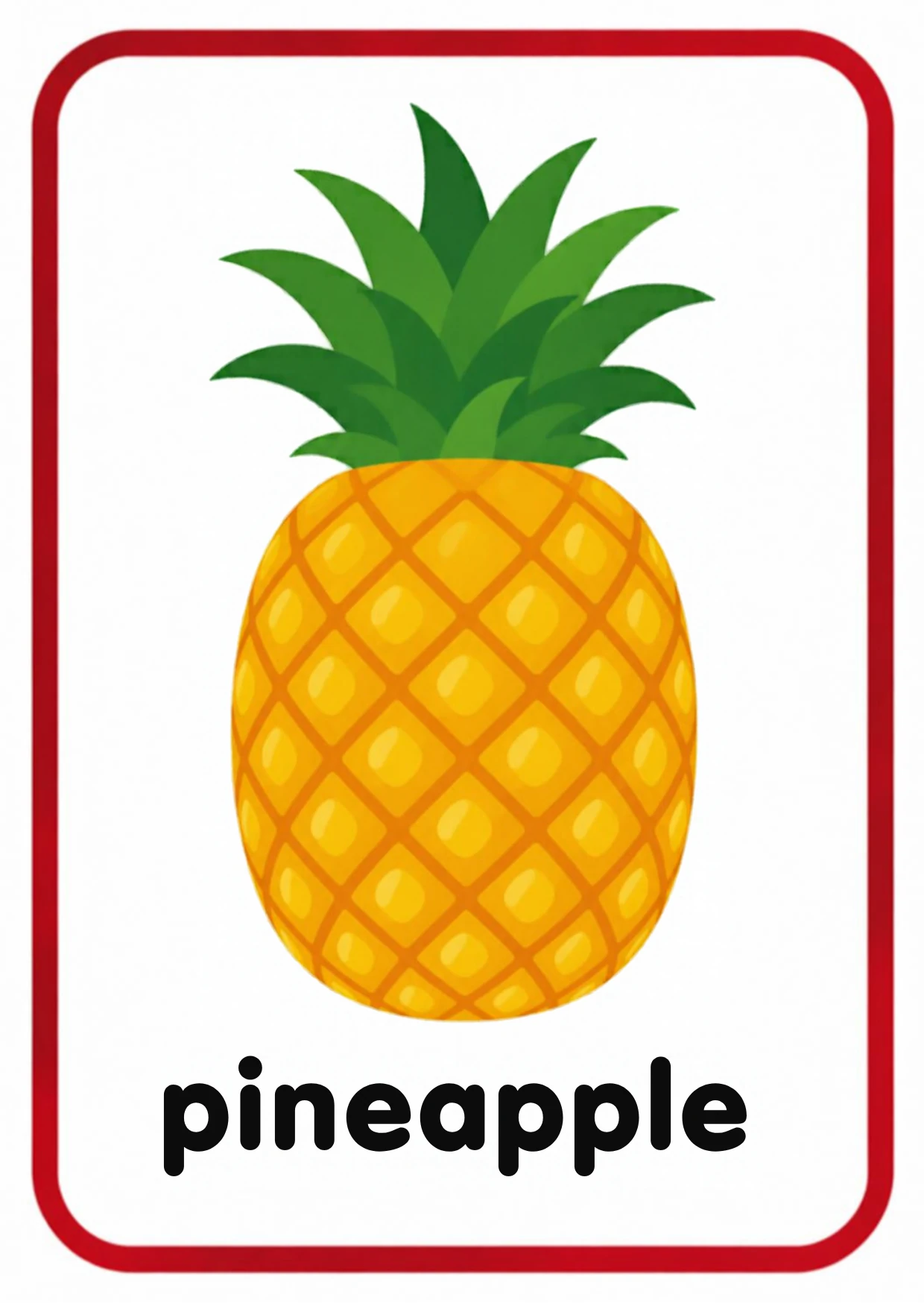
A pineapple is a big golden fruit with a tough, spiky, diamond-patterned skin and a crown of stiff green leaves. The card shows a yellow pineapple with its spiky green crown. It grows on a leafy plant close to the ground in warm countries — the crown is pure decoration.
What does it mean?
The pineapple’s secret — ground fruit, tree-looking crown — teaches children that appearances write wrong stories: what looks like a tree-fruit is a ground-fruit. A child who enjoys being told a plant secret is learning that the natural world has hidden facts, and that knowing them is a pleasure, not a chore.
What does the child need to know?
Your child needs the word at the card, the secret — in the ground, on a plant, despite the crown — and the touch test: bumpy, hard pineapple, then smooth, soft banana. Two fruits, two skins, one lesson in describing surfaces. The tasting waits for a grown-up, because nobody peels armor with little hands.
Why this matters
Contrast descriptions — bumpy versus smooth, hard versus soft — are early science language, and the fruit bowl supplies the pairs. A child who can say “the pineapple is bumpy and the banana is smooth” has built a comparison sentence, which is grammar and observation holding hands.
What it teaches
Tactile vocabulary (bumpy, spiky, hard, smooth), contrast descriptions in full sentences, botanical myth-busting (ground fruit, not tree fruit), patience while the grown-up does the armor-peeling, and tropical-plant curiosity.
Words to learn
pineapplecrownspikygoldensweetbumpy
Say this to your child
““Pineapple! Look at it — it wears a CROWN! But here is the secret: it grows down in the soil, not up in a tree. Feel the skin — bumpy! Hard! Like armor. And inside, it is golden and sweet. The grown-up opens the armor; we do the tasting and the crowning.””
Step by step
- Show the card and say pineapple — then ask what the fruit is wearing on its head. A crown! Say the word again like a royal announcement.
- Tell the secret: despite the crown, pineapples grow in the ground on leafy plants in warm countries. Say it like gossip — children keep plant secrets well.
- The touch test, hands washed: feel a real pineapple — bumpy, hard, heavy — then a banana — smooth, soft, light. Say both pairs out loud.
- The tasting is a grown-up job from end to end: the skin comes off with a big knife, and your child receives golden rounds or chunks, washed hands, sitting down.
- Close with the crown: draw or cut a paper crown for the fruit bowl’s new monarch — the word got said, the secret got kept, the throne got decorated.
Look closer at the picture
Look at the card together: it shows a yellow pineapple with a spiky green crown and the word pineapple underneath. Ask your child to find the crown, count the spiky leaves they can see, and say what the skin’s pattern reminds them of.
Ask your child
“Does a pineapple grow in trees or in the ground?” “What is the fruit wearing on its head?” “Which is bumpy — the pineapple or the banana?” “Who gets to do the cutting?”
What your child can say or do
Your child might retell the ground-secret to anyone who visits, stroke the bumpy skin like a museum piece, or appoint the fruit bowl’s pineapple “the king” — a fruit with a title and a biography is a fruit whose word has moved in permanently.
Out in the real world
Pineapples appear whole in the shop and pre-cut in tubs, and either way the word rehearses: crown up, crown off, armor and all. The bumpy-versus-smooth game extends to the whole kitchen — oranges, coconuts in books, the family dog.
Try it together
The touch museum: a whole pineapple, crown and all, travels from hand to hand — bumpy! hard! heavy! — next to a smooth banana for contrast, while your child announces each feeling like a tour guide. The grown-up removes the armor later; the tasting is golden chunks, eaten sitting down like royalty.
Understanding check
Ask: “Where does a pineapple grow — the secret? What does it wear? Who peels the armor?” The ground, the crown and “the grown-up” — that is the lesson landed.
Parent tips
If your child refuses the first chunk — pineapples tingle — say why: the fruit carries a tiny bite of its own, a little acid that tickles. Naming the tingle turns a refusal into a sensation worth investigating, and the second chunk often goes down as research.
Staying safe
Pineapple armor is strictly a grown-up job: the skin is tough, the knife is big, and the crown is spikier than it looks. Small eaters receive peeled, cored chunks — and the crown itself stays decorative, not chewable.
This lesson pairs with the Pineapple flashcard in the library — print it, show it, keep it on the fridge. Back to Fruits & Vegetables Flashcards.