
Camel — a step-by-step lesson for grown-up and child
This lesson teaches the desert as a real home — hot, dry, wide and full of sand — and walks through the camel’s equipment piece by piece, starting with the biggest mix-up of all: what the hump actually holds.
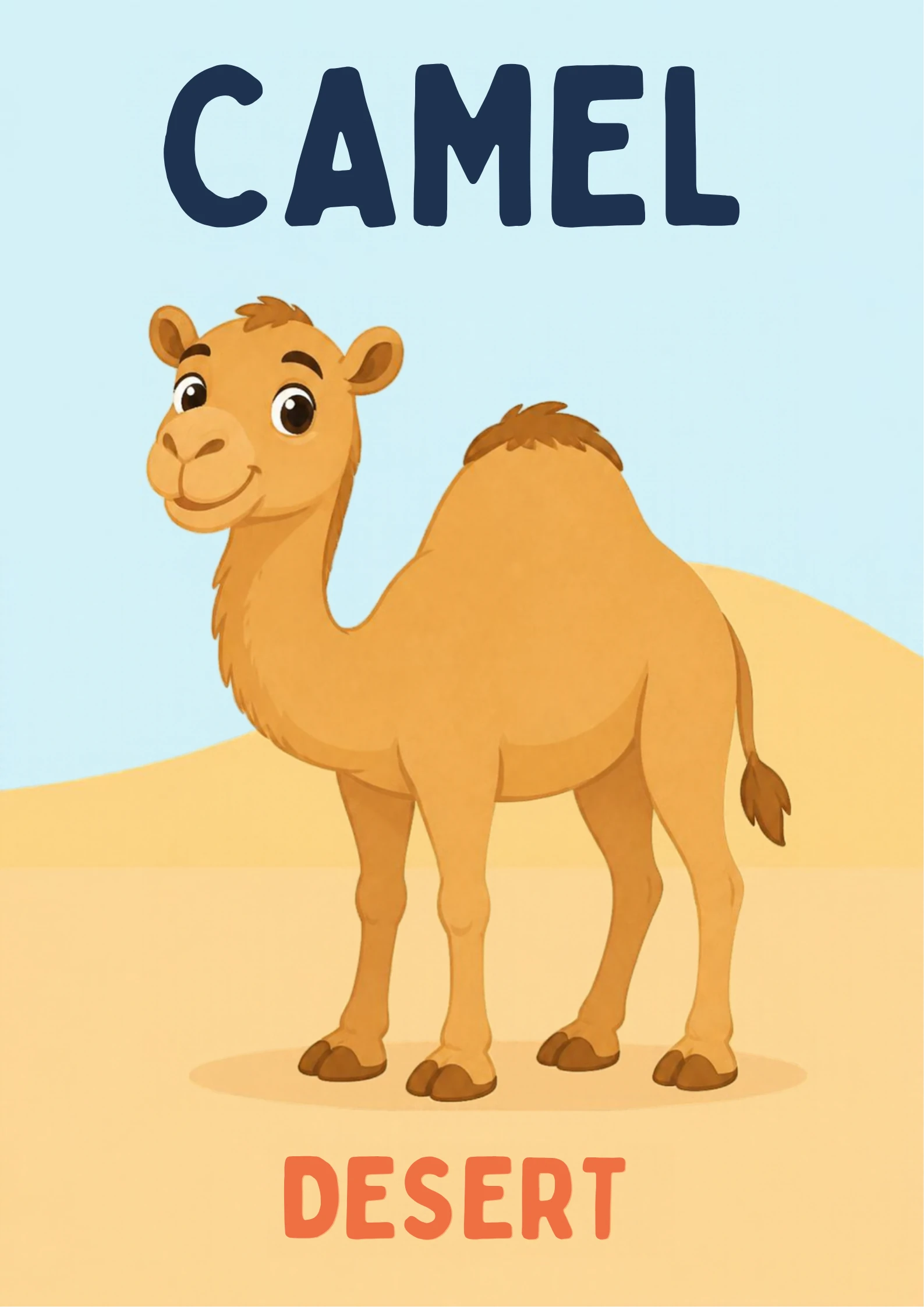
What is this?
A desert is a land of very little rain — rolling dunes, bare rock, blazing days and chilly nights. Few plants grow, water hides in rare wells and oases, and the sand itself shifts with the wind.
What does it mean?
Every desert problem has a camel part as its answer. Scorching sun: long eyelashes and closable nostrils keep the sand out. Burning ground: wide padded feet that spread on soft sand like snowshoes. Long empty miles between wells: a hump that stores fat — not water! — to burn as travel fuel. The camel is not just in the desert; the desert is written all over it.
What does the child need to know?
Your child needs three desert ideas: deserts are the driest lands on Earth, all sand, rock and rare water; the camel’s hump stores fat for the long journey — not water; and its feet, lashes and nostrils are each a piece of desert equipment.
Why this matters
The camel delivers body-part reasoning at its clearest: hold up a problem (sun, sand, distance), name the part that solves it. Children learn to read an animal like a toolbox — a habit of thinking that transfers to every animal they will ever meet.
What it teaches
Problem-and-solution matching, sun-safety parallels (lashes like sunglasses, shade-seeking), balance skills through dune-walking games, and myth-busting confidence — your child now knows something most grown-ups get wrong.
Words to learn
cameldeserthumpduneoasislashespadded feet
Say this to your child
“"The camel lives in the desert, where the sun is hot and the sand goes on and on. Its hump is full of fat, not water — food for the long walk. Its lashes keep the sand out, its wide feet stay on top of the dunes, and on it goes, mile after mile."”
Step by step
- Show the card: "This is a camel, and this is its home — the desert."
- Fix the mix-up first, proudly: everyone says the hump holds water. It does not — it holds FAT, packed fuel for the long walk between wells.
- Run the equipment check: long lashes and shut-tight nostrils against the sand; wide spongy feet that grip soft dunes; knees built to kneel on hot ground.
- Explain the distance: in the desert, wells and oases sit far apart — the camel is the animal that crosses the gap and arrives ready for more.
- Play the dune walk (below) and close with the summary: sun, sand, distance — a part for every problem.
Look closer at the picture
On this card a sandy-tan camel with one neat hump, a short mane and a gentle face stands on firm sand, rolling dunes rising behind it under a pale clear sky. The word "desert" sits below — one traveller, at home between the dunes.
Ask your child
"What does the hump really store?" "Why does the desert not bother the camel’s eyes?" "Why are its feet so wide?" "What do we call a green, watery spot in the desert?"
What your child can say or do
Your child might say: "The hump is fat, not water — for the long walk!" "Its lashes stop the sand," or the feet line: "Wide feet so it doesn’t sink in the sand!"
Out in the real world
Sun-gear comparison works anywhere bright: sunglasses as lashes, hat as shade-seek, water bottle as oasis plan. On sand at a beach or sandpit, test the feet rule yourself — flat hands or shoes sink less than heels. The camel’s engineering is kid-testable.
Try it together
Dune walk: lay a line of cushions or a strip of tape as a "dune ridge". Camel rules: heel-to-toe, arms out, eyes up — wobble off and it is back to the start oasis. Round two carries cargo (a beanbag on the head — the hump). Steady, wide, unhurried: the camel gait is the winning gait.
Understanding check
Ask: "What does the hump store? Name two camel parts that beat the desert. Where does a camel walk between?" Fat, lashes-and-wide-feet, well to well — three answers and the caravan moves on.
Parent tips
Let your child correct YOU on the hump at least once — act the mistake ("the hump is full of water, right?") and enjoy the triumphant "NO — FAT!". Being the family expert on one fact is a memory glue no drill can match.
Staying safe
Desert talk is sun-safety talk: hats, water and shade are the human version of lashes and humps. On real hot days, drink before thirsty and never play unattended near water — even the oasis has rules.
This lesson pairs with the Camel flashcard in the library — print it, show it, keep it on the fridge. Back to Animals & Their Habitats (Class 36).