
Ant — a step-by-step lesson for grown-up and child
This lesson turns a pavement ant into a first science project: your child finds the trail, sets a tiny test, and watches a whole team answer the call — patience, prediction and teamwork, all in one crack in the pavement.
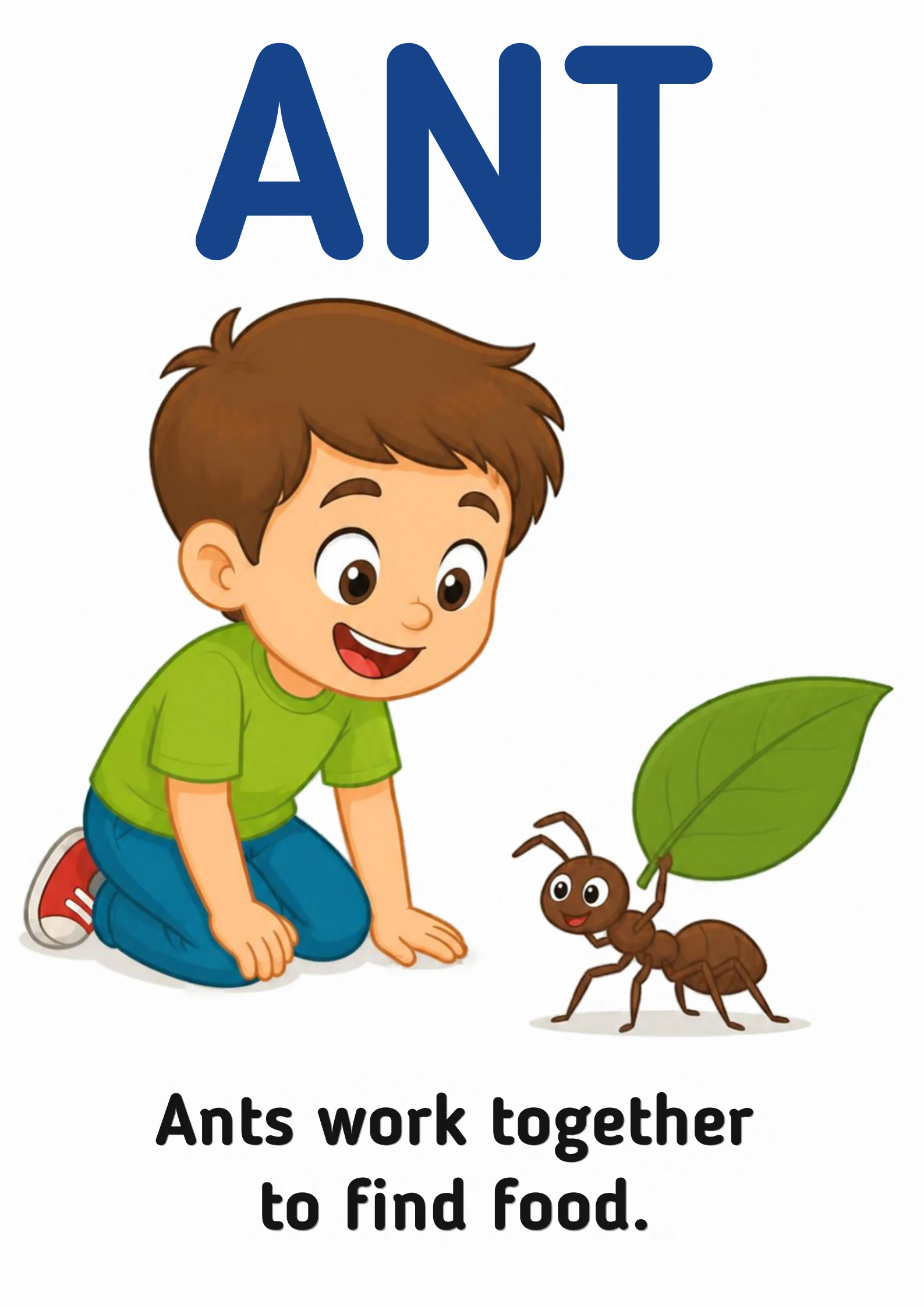
What is this?
Ant teamwork means jobs shared out: a scout finds food, leaves a smell trail on the way home, and the rest of the nest follows that scent line until every crumb is carried away.
What does it mean?
No ant is giving orders; each one follows simple rules — follow the smell, pick up a piece, head home. From those small rules comes something big: a line of workers that behaves like one super-organism.
What does the child need to know?
Ants live in nests with a queen and thousands of workers. They lift loads far heavier than their own bodies, and the trails you see are scent roads — if a raindrop washes one away, the line falls apart until it is rebuilt.
Why this matters
Watching ants teaches two science habits at once: look first, touch nothing, and let the evidence answer. It also plants the idea that small animals run on systems — a thought your child will reuse on bees, fish and even people.
What it teaches
Observation skills (watching without disturbing), prediction ("how many will come?"), counting, patience, and early systems thinking — many small workers, one big result.
Words to learn
anttrailteamscentcarrynest
Say this to your child
“"One ant found this food and told the others with a smell line only ants can read. Now the whole team is carrying it home, piece by piece. Watch how they pass each other without bumping — every ant knows its job, and nobody is the boss."”
Step by step
- Show the card and ask what the child in the picture is watching — and what the ant is carrying. Name the skill: watching a team at work.
- Find a real ant line on a pavement, wall or garden path. Hands behind backs: scientists watch, they do not poke.
- Set the crumb test: drop one small breadcrumb just off the path of the line and guess how long the first ant takes to find it.
- Count together as more ants arrive — first one, then three, then more than your child can count. Ask what told them where to come.
- End with the idea: the first scout left a smell road, and every ant that followed read it with feet and feelers. That is how a team talks without a single word.
Look closer at the picture
Ask your child: who is the child watching, and what is the ant carrying? Is the leaf bigger than the ant itself? Where do you think the ant is taking it? Can you find where the ant line might be going?
Ask your child
"How did the first ant tell its friends about the food?" "What do ants carry food on?" "What happens if you put your finger on their path?" "Who is the boss of the ant team?"
What your child can say or do
"Ants smell with their feet!" (close — the feelers and legs do the reading), "I counted twelve ants!" Your child may march in a line behind a sibling pretending to carry crumbs, or set a crumb test for ants on every walk.
Out in the real world
Ant teams show up everywhere: pavement cracks, picnic blankets, garden walls, the gap under a flowerpot. Once your child knows the trail rule, every walk becomes a chance to spot a team on shift — and to leave them to it.
Try it together
Crumb relay: you are the scout who finds a "crumb" (a block) across the room; your child smells the trail with a nose-wiggle, then the whole family forms a line and passes crumbs hand to hand to the "nest". Racing the clock makes the teamwork visible.
Understanding check
Ask: "How do ants tell each other about food? Who is the boss? What do scientists do first — touch or watch?" Scent trail, no boss, watch first = landed.
Parent tips
Pick slow pavement edges rather than nests — disturbed ants swarm, which frightens small children. If your child wants to "help" the ants, suggest carrying the crumb test to them, not the ants to the crumb: it respects the workers and keeps fingers safe.
This lesson pairs with the Ant flashcard in the library — print it, show it, keep it on the fridge. Back to Science, Nature & Discovery (Class 31).