
Feather — a step-by-step lesson for grown-up and child
This lesson answers two bird questions with one object: how do birds fly, and how do they stay warm? Your child races a feather against a stone, watches the air catch every strand, and looks close enough to find the tiny hooks that zip a bird’s coat shut.
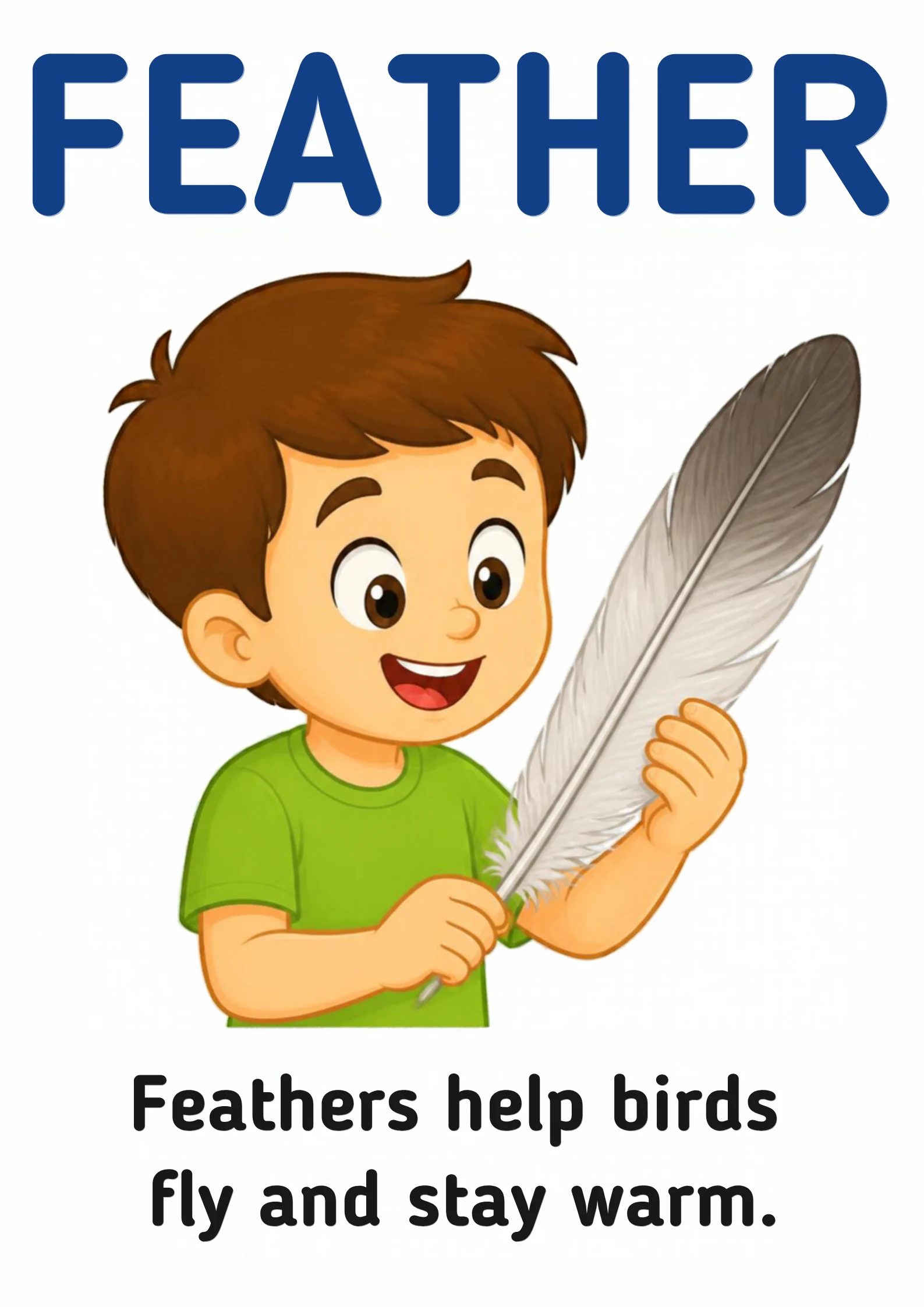
What is this?
Feathers are a bird’s built-in gear: long flight feathers catch the air for flying, and soft fluffy down feathers trap warm air close to the body like a duvet. A bird can have thousands of them, zipped neat with its beak.
What does it mean?
The feather wins the drop race because the air catches it: light, wide and spread into strands, it falls slow — while the stone drops straight through. Down works the same trick for warmth: feathers trap air, and trapped air is the best blanket there is.
What does the child need to know?
Birds preen — zipping their feathers tidy with their beaks, like combing a coat. Flight feathers are built from a hollow stem with strands branching off, and those strands hold tiny hooks that clip together. Your winter jacket and sleeping bag copy the fluffiest feathers, strand for strand.
Why this matters
The feather-versus-stone race is a fair test your child can run off any park bench — and the answer (air catches it) links feathers to flying. Finding hooks on a real feather shows that gear can be tiny, and the jacket connection brings bird science to the coat rack.
What it teaches
Fair testing (same height, drop together), cause-and-effect with air resistance at playground scale, close observation with a magnifier, and the design idea: birds and coat makers solved the same problem the same way.
Words to learn
featherbirdflywarmdownair
Say this to your child
“"A feather does two jobs for a bird: the long ones catch the air for flying, and the fluffy ones hold warm air like a duvet. Watch — drop a feather and the air catches it, strand by strand, so it floats down slow. The stone has no such trick; it just drops. And your winter coat? It copies the fluffy kind."”
Step by step
- Show the card: what is the child holding — soft or scratchy? What color is the feather? Name its two jobs: flying and warm-keeping.
- Run the drop race: feather against a small stone, released together from the same height. Which floats, which thuds? The air grabs every feather strand.
- Explain the flying: wide flight feathers push against the air like oars — a bird flaps, catches air, and stays up. Stone could never.
- Tell the warm secret: under the flight feathers sits fluffy down that traps warm air — your winter jacket is stuffed with the same idea.
- Look close on a real feather: smooth vane on one side, fluffy on the other, and along the strands — tiny hooks that zip the whole thing shut.
Look closer at the picture
Ask your child: what is the child holding? Is the feather soft or hard? What color is it? Who do you think the feather belonged to?
Ask your child
"What are a bird’s two kinds of feathers for?" "Why does a feather fall slower than a stone?" "What do birds do with their beaks to keep feathers neat?" "What does your winter coat copy from birds?"
What your child can say or do
"The air catches the feather — that is why it floats!" "My coat has down — bird stuff, copied!" Your child may drop leaves, scarves and paper alongside stones all week, preen their own hair in front of the mirror like a bird, or inspect every found feather for hooks.
Out in the real world
Feather signs are everywhere: the pigeon feather by the bus stop, the duvet on your child’s bed, the duck shaking water off its back — water rolls off because preened feathers are zipped tight. The park is a feather showroom; the coat rack is the copycat aisle.
Try it together
Feather-versus-anything Olympics: race a feather against a coin, a leaf, a scarf square and a crumpled paper ball — same height, drop on the count of three. Rank the floaters, then untie the mystery: wide and light floats, small and heavy drops. The air is the judge.
Understanding check
Ask: "What do feathers do for birds? Why does a feather float down slowly? What is your winter coat stuffed with?" Fly and warm, the air catches it, down = landed.
Parent tips
Found feathers get a gentle wash-and-dry before close looking — and a magnifier turns the hooks from a claim into a sighting. Shop feathers work for the race too, but a real one shows the zip. If a bird lets you watch it preen, you have seen the whole lesson in ten seconds.
This lesson pairs with the Feather flashcard in the library — print it, show it, keep it on the fridge. Back to Science, Nature & Discovery (Class 31).