
Rainbow — a step-by-step lesson for grown-up and child
This lesson cracks the sky’s best trick: white sunlight is secretly a whole family of colors, and raindrops are the mirrors that split it apart. Your child learns the two-ingredient recipe — sun behind, drops in front — then makes a rainbow on demand with a spray.
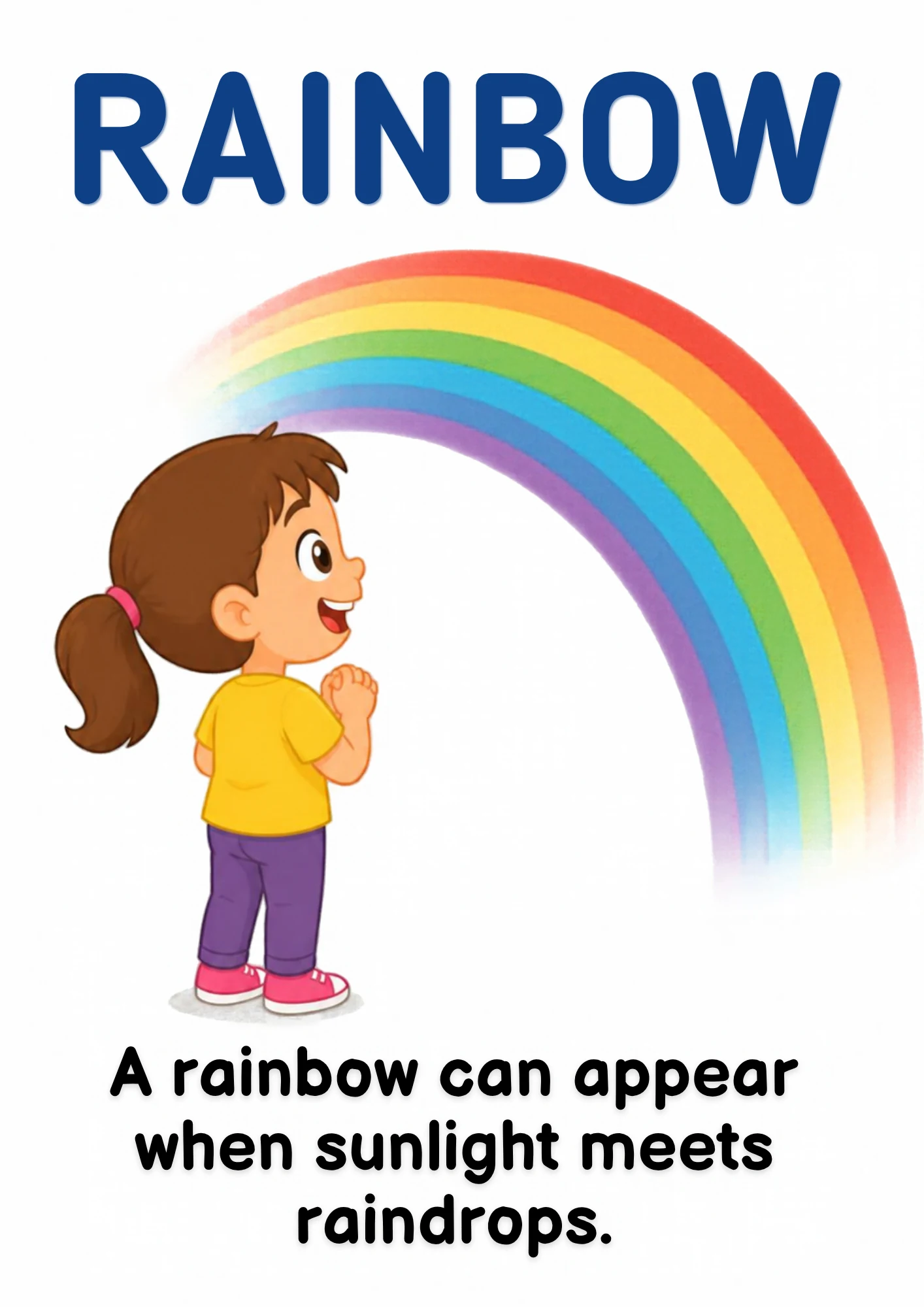
What is this?
A rainbow appears when sunlight shines through falling raindrops: each drop splits the white light into its colors, and millions of drops together paint an arc across the sky. Sun AND rain, each in its place, or no rainbow at all.
What does it mean?
White light is a mix hiding in plain sight — a raindrop is a tiny prism that unmixes it. The recipe needs both ingredients at once: sun on one side, drops on the other. That is why rainbows visit while rain is leaving, not while it is pouring on your head.
What does the child need to know?
Look carefully and a rainbow carries seven colors: red, orange, yellow, green, blue, indigo, violet. The rule for finding one: stand with the sun behind you and the drops in front. The same trick works with a hose mist or a spray bottle on any sunny day.
Why this matters
Rainbows are light science your child can point at and even manufacture — the spray-bottle recipe turns waiting for weather into making it. The two-conditions rule (sun behind, drops ahead) is also early cause-and-effect: no ingredients, no rainbow.
What it teaches
Observation of a fleeting phenomenon, counting and naming colors in order, cause-and-effect with two required ingredients, and the maker-mindset: recreating nature’s trick at garden-hose scale.
Words to learn
rainbowlightcolorsraindropssunarc
Say this to your child
“"Sunlight looks white, but inside it hides every color you can name. When sun shines through raindrops, each little drop splits the light like a prism — and a whole arc of drops paints the rainbow across the sky. Want the recipe? Sun behind you, rain in front. We can even make one with the spray bottle!"”
Step by step
- Show the card: what is the child looking up at, and can you name the colors you see? Count them together, top to bottom.
- Tell the secret: sunlight looks white, but it is secretly carrying every color — a raindrop splits it apart like a key opening a box of paints.
- Learn the recipe: sun behind you, drops in front of you — both at once, or nothing appears. That is why rainbows come out as rain moves away.
- Make your own: on a sunny day, stand with your back to the sun and spray a fine mist into the air — a small rainbow hangs in the water.
- Play color spotter: find all seven in the arc, then hunt them off the sky — red postbox, yellow banana, violet plum. The rainbow’s family is everywhere.
Look closer at the picture
Ask your child: what is the child looking up at? How many colors can you find in the rainbow? Can you name one of them? Does the child look happy to see it?
Ask your child
"What two things do you need to make a rainbow?" "Where does the sun need to be standing?" "What does a raindrop do to white light?" "How many colors live in a rainbow?"
What your child can say or do
"Sunlight has all the colors hiding inside!" "Sun behind, drops in front — I can make one!" Your child may carry the spray bottle on every sunny walk, demand rainbow checks during every shower, or name the seven colors in order like a spell.
Out in the real world
Rainbow conditions show up weekly: sun shower, spray at the fountains, the hose on the lawn. Once your child knows the recipe, they stop waiting and start engineering — back to the sun, mist in the air, and there it hangs. Bubbles and CDs carry the same color-splitting trick indoors.
Try it together
Prism stations: a glass of water on a sunny windowsill throws a small rainbow on the floor; a CD under a lamp scatters colors; bubbles wear moving ones. Send your child on a rainbow hunt around the house — where else does light get split apart?
Understanding check
Ask: "What two things make a rainbow? Where does the sun stand? What does a drop do to light?" Sun and raindrops, behind you, splits it into colors = landed.
Parent tips
The spray-bottle rainbow takes a try or two — fine mist, low sun, and your back squarely to it. Morning and evening sun make the biggest arcs. If the real sky delivers one, drop everything and run out: a first wild rainbow is a core memory.
This lesson pairs with the Rainbow flashcard in the library — print it, show it, keep it on the fridge. Back to Science, Nature & Discovery (Class 31).