
Tree Parts — a step-by-step lesson for grown-up and child
This lesson upgrades the biggest plant your child knows from background scenery to a machine with named parts: roots that drink, a trunk that lifts, leaves that cook — all found on one walk, all touchable, one of them rub-able with crayons.
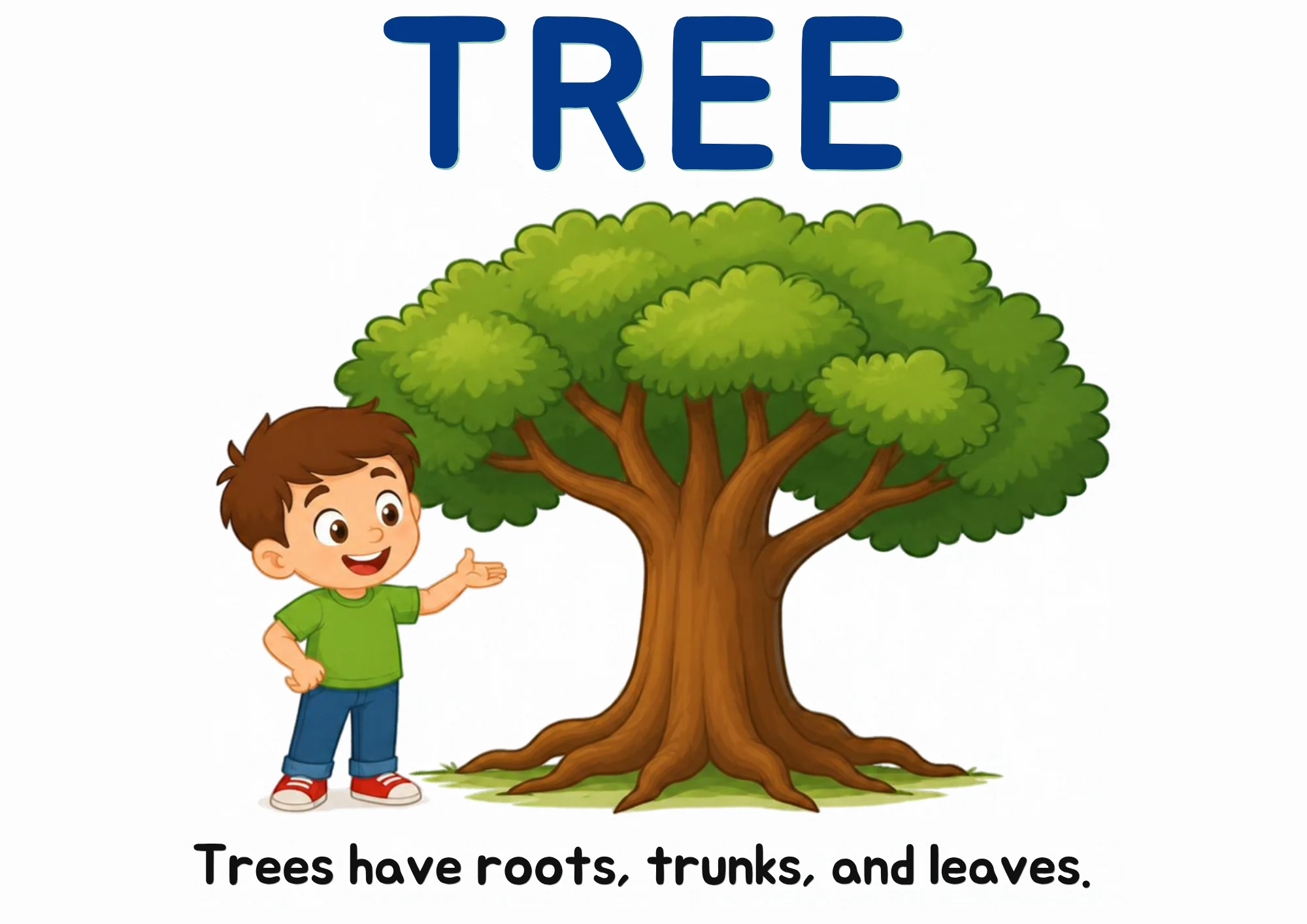
What is this?
A tree is built in three working parts: roots spread underground, drinking water and holding everything up; the trunk is the lift shaft hauling water to the crown; the leaves up top are the kitchen where sunshine turns into tree food.
What does it mean?
Every part has one job and the jobs chain together: drink, lift, cook. A tree is the plant-needs lesson standing up — water from below, light from above — scaled to a size your child can hug, and it lives in one place for decades doing the same three jobs.
What does the child need to know?
On a hot day a big tree hauls hundreds of buckets of water up its trunk. Roots peek above soil at the base — easy to find on old trees. Bark is the trunk’s armour, and every kind of tree wears its own pattern: rough oak, peeling birch, smooth beech.
Why this matters
Naming parts turns any tree into a readable system your child owns: here is the drinking bit, the lifting bit, the cooking bit. It scales the plant idea up, sets up bark-and-leaf collecting as a science hobby, and makes every street walk a tree tour.
What it teaches
System thinking with parts and jobs, tactile observation (bark rubbings, leaf textures), sorting and comparing collected leaves, and scale — the same plant plan, from bean jar to giant oak.
Words to learn
treerootstrunkbarkleavesbranches
Say this to your child
“"A tree is a three-part machine. The roots drink water from the soil, the trunk is the lift that carries the water up, up, up, and the leaves at the top catch sunshine and cook the tree’s food. Bark is the trunk’s armour — rub your crayon over it and it writes you its pattern."”
Step by step
- Show the card: who is standing next to what, and is the tree taller than the child? Name the three parts — roots, trunk, leaves.
- Assign the jobs: roots drink underground, the trunk lifts the water all the way up, the leaves catch sunshine and cook.
- Find a big tree and inspect the base: can you see roots peeking out of the soil? That is the drinking crew, showing up for work.
- Rub the trunk: paper and a flat crayon over the bark print its armour pattern. Compare with the next tree — same pattern or different?
- Collect three fallen leaves — different shapes welcome — and finish the chain out loud: drink, lift, cook. The whole tree in three verbs.
Look closer at the picture
Ask your child: what is standing beside the child? Is the tree taller than the child? Can you find the trunk? Where are the leaves — up high or down low? What is the child looking at?
Ask your child
"Which part of the tree drinks?" "What does the trunk carry, and where to?" "What do the leaves do all summer?" "What is the bark for?"
What your child can say or do
"The trunk is a water lift!" "I can see the roots — they came out to wave!" Your child may hug every big tree on the walk, collect leaves by the carrier-bagful, or point out drinking roots and lifting trunks wherever trees grow.
Out in the real world
Trees are the fixed landmarks of childhood: the climbing tree, the conker tree, the one outside the window. Once parts have names, a walk becomes an inspection route — and a fallen big branch shows the rings inside, one ring per year, like a birthday count.
Try it together
Be the tree: your child crouches as roots (fingers wiggling underground), rises as the trunk (arms lifting, up, up), and bursts as leaves (hands fluttering at the top). Call the parts in any order; then swap and let them call your tree parts.
Understanding check
Ask: "What do roots do? What does the trunk do? What do leaves do?" Drink, lift, cook = landed.
Parent tips
Fallen leaves only — picking live leaves is stealing the tree’s kitchen, and your child can respect that. Bark rubbings work best on smooth bark with the paper taped down; label each rubbing with the tree’s spot so the collection becomes a map.
This lesson pairs with the Tree Parts flashcard in the library — print it, show it, keep it on the fridge. Back to Science, Nature & Discovery (Class 31).