
Blue — a step-by-step lesson for grown-up and child
Blue gets a whole day because it fills the sky, and the sky is the biggest picture your child looks at. This lesson teaches the word at the splash, anchors it to a little blue car, then lifts everyone’s eyes upward — because blue is the rare color that arrives above your head for free, every single morning.
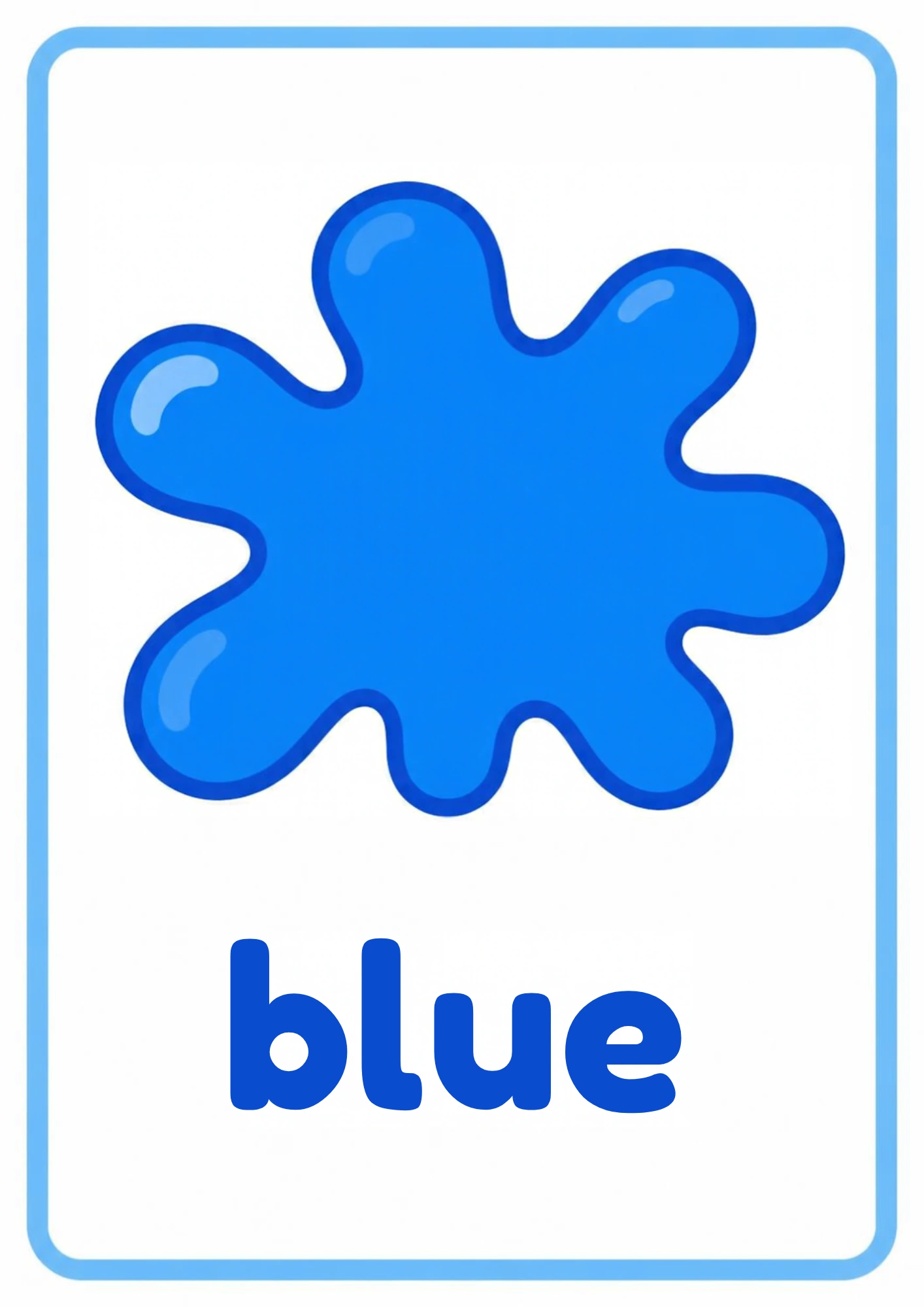
What is this?
Blue is the name for the color shared by the sky, the sea and thousands of small things: this card’s car, jeans, a blueberry, a wheelie bin. The splash card holds the color alone, the picture card shows it riding on something real, and your street supplies the rest.
What does it mean?
Blue teaches a quiet, powerful idea: one word can cover things of very different sizes — a car and the whole sky. A three-year-old who accepts that is doing real categorising: the word travels with the color, not with the object. That is abstraction in training wheels, and it deserves celebrating when it clicks.
What does the child need to know?
Your child needs to hear blue said clearly at the splash, find at least one real blue twin nearby, and experience a spotting walk where blue things get counted out loud. Shade-words like navy and sky-blue can wait years — at three and four, everything blue is simply blue, and that is exactly right.
Why this matters
Blue-spotting trains distance vision and careful looking: much of the world’s blue sits far away, at the top of the view. A child practising “look up, look far” is building the same attention that later finds a friend in a playground and a letter inside a word.
What it teaches
Colour categorising, distance observation (sky, roofs, far cars), counting during spotting games, and the patience that comes from watching for something that is not always there — the sky is not blue every day, and noticing that is science.
Words to learn
bluecarskyspotlookmatch
Say this to your child
““Blue! The whole card is blue — top to bottom. And here is a little blue car, beep beep! Blue rides in cars, it hides in blueberries, and sometimes the whole sky wears it. Let us count blue cars on our walk — ready? Eyes up, spotters!””
Step by step
- Show the splash card and say blue twice — the whole card is one wash of it, so the word has nothing to compete with.
- Turn to the picture card: a little blue car with the word blue. Say the word at the car, then beep the horn together — silly, and it sticks.
- Hunt the house for blue: a sock, a book, a toy, the tube of toothpaste. Touch each find and say the word as you go.
- Take the hunt outside and count blue cars as they pass — one sighting is a win, and a whole queue of them is a parade.
- Finish by looking straight up: on a clear day the biggest blue thing of all is overhead, and your child gets to name it.
Look closer at the picture
Compare the two cards: the splash card is one big wash of blue with the word blue on it, and the picture card shows a little blue car wearing the same word. Ask your child whether any of the splash’s blue also sits on the car, and what color the wheels are not.
Ask your child
“Which is bigger — the blue car or the blue sky?” “Can you find two blue things that are not the same shape?” “Is your cup blue today?” “What would happen if the sky turned green?”
What your child can say or do
Your child might beep at every passing car, announce “blue sky!” before breakfast, or point at your jeans with great pride — naming blue on things you are wearing is a very good sign that the word has left the card and moved into the world.
Out in the real world
Blue turns up more than most colors once you hunt it: the car park, the letter box, a neighbor’s door, the recycling bin. Name the finds as they happen and the word rehearses itself — no lesson required, only eyes up and out.
Try it together
Blue treasure plate: at tidy-up time, your child collects every blue thing they can find onto one plate and presents it to you for counting. The collection is the trophy; the counting is a numbers lesson sneaking in behind the colors.
Understanding check
Ask: “Show me blue. Where is the little car? Find one blue thing above your head.” The right card, the car named and a ceiling, roof or sky pointed at — that is the color landed.
Parent tips
If your child insists the green grass is blue, swap roles — you be the confused one and ask which card the grass matches. Sorting the two splashes themselves beats being told, and the grass keeps its dignity.
This lesson pairs with the Blue flashcard in the library — print it, show it, keep it on the fridge. Back to Colors & Color Mixing (Preschool).