
Angry — a step-by-step lesson for grown-up and child
This lesson teaches angry on purpose, in a peaceful moment, long before the next storm: the face gets studied, the word gets practised, and the rule gets agreed while everyone is calm.
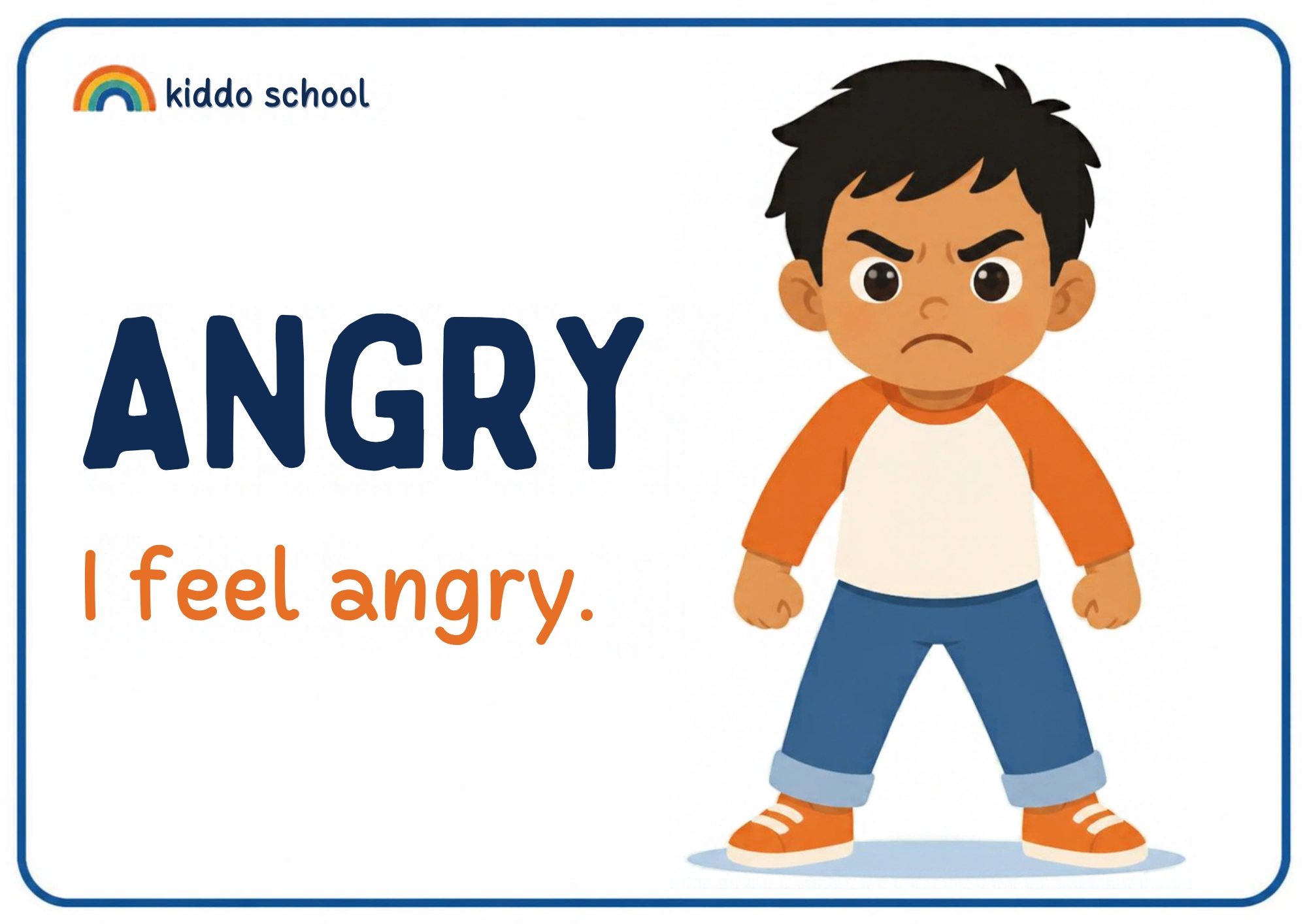
What is this?
Angry is the hot feeling — clenched fists, loud voice, a body that wants to explode. The card shows the face with no thunder attached, which is exactly why it works.
What does it mean?
Anger named in advance becomes survivable in the moment: a toddler who owns the word has a handrail while the feeling roars. The feeling is allowed; what the body does with it has rules.
What does the child need to know?
Play the card when everyone is calm, not mid-meltdown. In the storm, keep it to two words — you are angry — and save the rest for after, when the card and the story can meet again.
Why this matters
Anger visits every day at two: the block that fell, the shoe that lost, the biscuit that is gone. A word and a plan turn each storm from a catastrophe into weather.
What it teaches
Feeling vocabulary for big storms, body-awareness, and the first behaviour rule — all feelings are welcome, hurting is not.
Words to learn
angrycrossroarstompstormcalm
Say this to your child
“"Angry! This face is feeling angry — look at those eyebrows. Can you make an angry face? Grrr! When you feel angry, stomp and roar — and I will stay right here. All feelings are welcome; hurting is not."”
Step by step
- Show the card in a calm moment and name it strongly: angry — this face is feeling angry. Let the word sound big and safe at once.
- Make the face together: scrunch, frown, growl a little roar. The pretending gives the feeling a rehearsal room with no consequences.
- Give the storm its safe outlets, agreed in advance: stomp your feet, squeeze your fists, roar at the ceiling — angry is allowed to be loud.
- Say the rule plainly, while everyone is smiling: all feelings are welcome, and hurting is not. We stomp, we squeeze, we never hit.
- In the next real storm, keep it tiny: you are angry. Two words, then quiet company. Afterwards, return to the card and let the story be told.
Look closer at the picture
The card shows an illustrated child having an angry feeling — one stormy face, safely framed. Ask your toddler to find the angry face, then to show you their best pretend growl.
Ask your child
"Where is the angry face?" "Can you make that face?" "What can we do when we feel angry?" "Is hitting allowed?"
What your child can say or do
A stomping march around the rug, a growl at the ceiling, or angry barked at the card itself — all are the word doing its work. Some toddlers go quiet and point; the pointing counts exactly the same.
Out in the real world
Storms arrive on their own schedule. In the moment, the word plus your calm presence is the whole lesson; the card comes back out afterwards, when the retelling turns a meltdown into a story with an ending.
Try it together
Stomp-and-roar corner: when the thunder starts, walk together to one safe spot and let the angry body do its permitted thing — stomping, roaring, squeezing a cushion. Then the storm always ends, and you are still there.
Understanding check
After the next storm passes, show the card and ask what that feeling was. Angry, said or pointed, means the word is moving in. Feet that stomped and hands that stayed kind mean the rule landed too.
Parent tips
Keep yourself dull and steady through real storms — your steadiness is the teaching. Afterwards, retell it warmly: you were angry, you stomped, it passed. The story teaches more than the storm ever could.
Staying safe
The line every toddler needs spoken out loud: all feelings are welcome, hurting is never allowed. Storms get safe outlets — stomping, roaring, cushion-squeezing — and a grown-up who stays close without joining in.
This lesson pairs with the Angry flashcard in the library — print it, show it, keep it on the fridge. Back to Emotions & Feelings (Toddler 7).